The safest cookware: every material compared
Cast iron, stainless, enamel, ceramic-coated, Teflon, hybrid, glass, clay, copper and aluminium: what each can put in your food, how good the evidence is, and the care that matters.
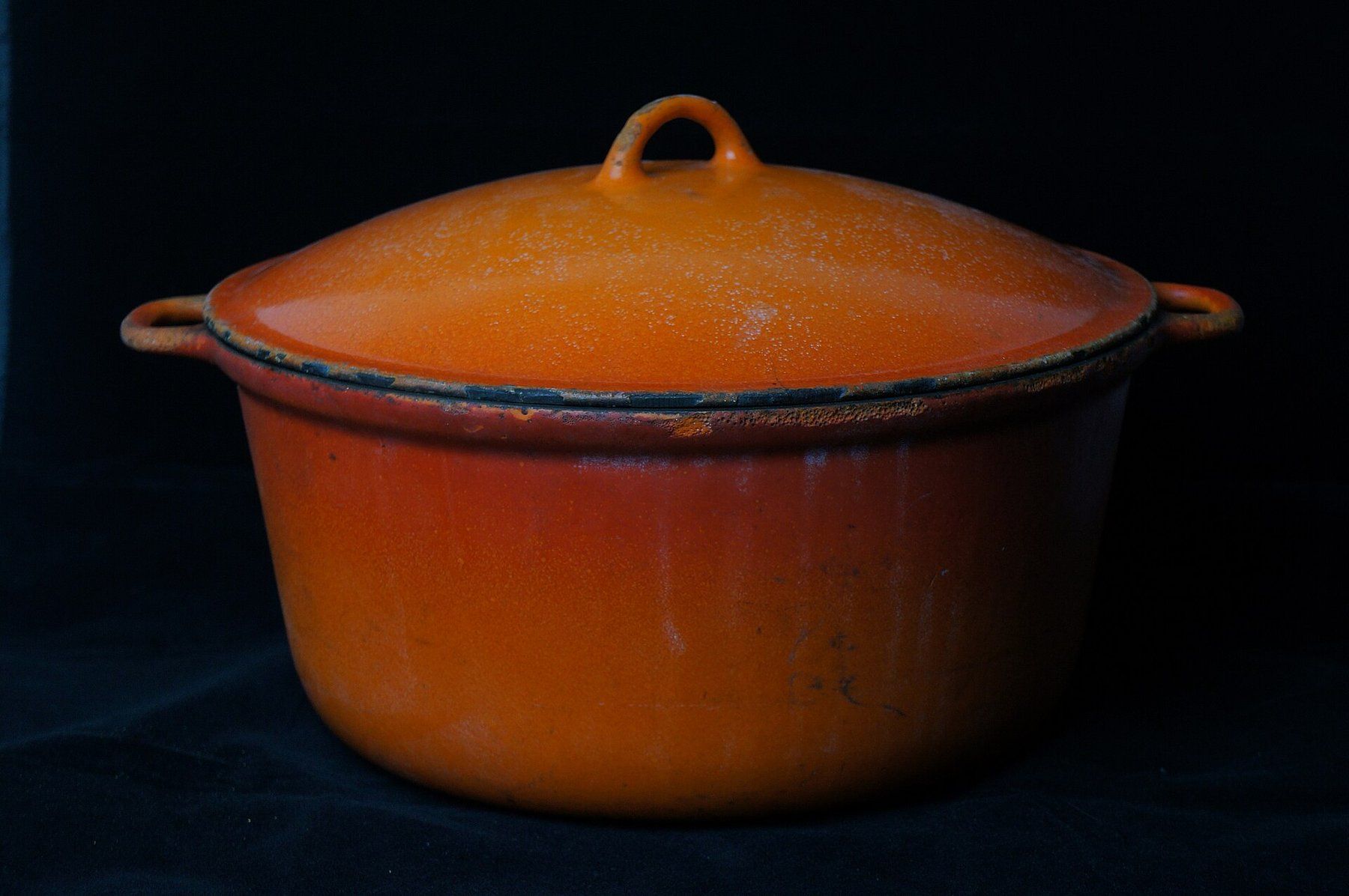
Search “non-toxic cookware” and you’ll find a lot of confident lists. Most of them rank pans by vibe. Here we do it by what the evidence says each material can put in your food, how strong that evidence is, and what you can actually do about it.
The short answer: no pan is chemically silent. Iron pans add iron, stainless adds a little nickel and chromium, aluminium adds aluminium, and coatings add bits of coating. Two harms stand out from the background noise: fumes from overheated PTFE nonstick, and lead from some glazes and some imported metal pots. Everything else is a trade-off you can manage with how you cook.
This page is a map. Where we’ve already gone deep on a material, we summarise and link rather than repeat ourselves.
Every material at a glance
“Meets our standard?” says whether a pan made of that material could pass the LPP product standard, which we use to vet products. It isn’t a verdict on any brand. Every part still has to be disclosed by the maker, including the handle and lid.
| Material | What can migrate | Strength of evidence | Care that matters | Meets our standard? |
|---|---|---|---|---|
| Cast iron | Iron, more with acidic, wet, long-cooked food | Good for iron transfer; little else measured | Season it; go easy on long tomato simmers | Can qualify, if the maker says what any factory seasoning is |
| Carbon steel | Iron, by analogy with cast iron | None specific: no studies found | As cast iron; strip any factory anti-rust coating as the maker says | Can qualify, on the same terms as cast iron |
| Stainless steel | Nickel and chromium, most from new pans and acidic food | Good (several lab studies) | Don’t christen a new pot with a six-hour tomato sauce; nickel-allergic people should take more care | Can qualify |
| Enamelled cast iron or steel | Lead and cadmium, if the enamel contains them and is poorly made or chipped | Thin: no studies of enamel cookware found | Retire chipped enamel; ask for a lead and cadmium statement | Only with a published lead and cadmium statement |
| Ceramic-coated (“PFAS-free” sol-gel) | Titanium and silicon particles from scratched coating | Thin (a few lab studies) | Medium heat, soft tools, replace when it wears | No, as we apply our standard today |
| PTFE nonstick (“Teflon”) | Fumes when overheated; PTFE particles when scratched | Strong for fumes; particles measured, health effects unknown | Never preheat empty; medium heat; replace when scratched | No: PTFE is a PFAS |
| Hybrid (steel ridges over nonstick) | Whatever the coating releases, plus steel’s nickel and chromium | None: no studies of hybrid pans found | Depends on the coating; the maker’s own care advice | No: it has a nonstick coating |
| Glass | Nothing meaningful; breakage is the risk | Good | Know whether it’s borosilicate or soda-lime; avoid sudden temperature changes | Can qualify |
| Clay and stoneware | Lead (and cadmium) from some glazes; metals from some unglazed clay | Strong for lead-glazed traditional pottery | Avoid crude, antique, worn or street-bought pieces for cooking; don’t store acidic food | Glazed: only with a published lead and cadmium statement. Unglazed: not covered by our standard yet |
| Copper, tin-lined | Tin lining wears; copper if it shows through | Regulatory guidance; no studies of tin-lined copper found | Don’t overheat (tin melts at 232 °C); re-tin when copper shows | Lined: can qualify. Unlined for cooking: not covered by our standard yet |
| Aluminium, bare or anodised | Aluminium, especially into acidic or salty food; lead from some imported pots | Good for acid-driven aluminium release; strong for lead in some imported pots | Don’t cook or store acidic or salty food in bare aluminium; avoid the pots on the FDA’s lead list | Bare: not covered by our standard yet. Coated: judged on the coating |
The rest of this page explains each row.
Cast iron and carbon steel
Bare iron has no coating to wear off. The “nonstick” layer that builds up is seasoning: oil baked onto the metal, not plastic. What iron pans add to food is iron. In one study, 90% of 20 foods had significantly more iron when cooked in iron utensils, with acidic, wet and long-cooked foods picking up most. That’s harmless or helpful for most people; if you’ve been told to limit iron, ask your doctor.
Carbon steel is cast iron’s thinner cousin, with the same seasoning. We found no studies measuring what it releases. It should behave like cast iron, but that’s an inference, not a measurement. Our nonstick pans guide covers both in more detail, including why iron pots aren’t a reliable fix for anaemia.
One thing to check: many iron pans come pre-seasoned, and new carbon steel often ships with an anti-rust wax or lacquer you’re told to scrub off. Under our standard, a coating the maker won’t name is a disqualifier, so we’d want to know what that factory layer is.
Stainless steel
Stainless steel is iron alloyed with chromium and, in the common 304 and 316 grades, nickel. New stainless leaches some of both into acidic food. In a lab study, tomato sauce cooked for six hours with stainless steel picked up up to 26 times more nickel than sauce cooked without it, and release fell after the first few cooking cycles. Under ordinary one-hour cooking in grade 316 pots, the amounts stayed below known allergy-triggering levels, though they may matter for people who are very sensitive to nickel.
So for most people stainless is one of the safest choices there is, with a learning curve (food sticks until you get the hang of heat and fat). Our stainless steel guide decodes 304, 18/10, 316 and 430, explains why a magnet can’t verify a grade, and is the place to start if you have nickel allergy.
Enamelled cast iron and enamelled steel
Enamel is glass fused onto metal. It doesn’t react with acidic food the way bare iron does, which is why enamelled pots are good for tomato sauce and braises. Its question is the same as a pottery glaze’s: lead and cadmium can be used in enamels and glazes, and a poorly made or chipped surface could release them.
We found no peer-reviewed study of lead or cadmium release from enamelled cookware, so we can’t tell you how often that happens. What we can tell you is what to ask for. Our standard won’t list enamel for food without a published lead and cadmium compliance statement. Some makers publish one. Staub’s US site says “Staub is Cadmium Free, Lead-Free, PFOA Free, PTFE Free, and PFAS Free.” It’s a brand-wide statement from the maker, not a test result for one pot, and for a listing our standard also wants third-party evidence of lead and cadmium compliance, but it’s the kind of thing to look for. (Staub also says the black interior of its pots is “our signature black matte enamel, not exposed cast iron”, a useful reminder that a dark interior isn’t necessarily bare iron.)
Retire enamel that’s chipped on the cooking surface: you’re then cooking on exposed metal and on an enamel edge that can keep flaking. Our kettles guide found the same gap in lead statements for enamel kettles.
Ceramic-coated pans and what “PFAS-free” means
Most “ceramic” pans aren’t ceramic in the pottery sense. They’re metal pans coated with a thin glassy film, usually called sol-gel, often bound with silicone. They don’t use fluoropolymers, so “PFAS-free” can be true. That’s a real advantage at the factory and the landfill.
It isn’t the same as “nothing comes off”. Slovenian researchers who analysed commercially available coatings of this kind found titanium dioxide and quartz in a silicone matrix, and scratch tests released titanium-containing nanoparticles. Nobody has shown whether swallowing such particles in kitchen-sized amounts matters. Ceramic coatings are less studied than PTFE, not proven safer, and they wear out.
Three things “PFAS-free” on a ceramic pan doesn’t tell you: what the coating is actually made of (makers rarely say), what else on the product is coated, and how long it lasts. Our air fryer investigation read makers’ claims line by line and found a “PFAS-free” promise often covers only one part, while makers using the narrower “made without intentionally added PFAS” are at least being precise.
Our standard treats ceramic nonstick the way it treats other nonstick coatings, so a ceramic-coated pan doesn’t pass. Treat one like nonstick: medium heat, wooden or silicone tools, no abrasive scrubbing, and replace it when it starts to wear.
PTFE nonstick, and where the law stands
Classic nonstick is PTFE (Teflon), a fluorinated plastic and a member of the PFAS family, whether or not the box says “PFOA-free”. The harm nobody disputes is overheating. Germany’s risk agency, the BfR, says PTFE starts to decompose at around 360 °C and above, releasing substances hazardous to health (breathing them can cause polymer fume fever, as our nonstick guide explains). The BfR says never to heat a coated pan empty, and to take particular care on induction and gas hobs, which heat very fast. Scratched pans also shed plastic: researchers estimated that thousands to millions of PTFE particles might come off during simulated cooking (more in our research library entry on that study). Whether swallowing them harms people is unproven.
Several US states now ban new cookware with intentionally added PFAS. As of November 2026:
- Minnesota has banned it since 1 January 2025. The law’s definition of cookware includes baking sheets, baking molds, trays and cooking utensils, not just pans. See our policy tracker entry.
- Colorado banned it from 1 January 2026.
- Maine banned it from 1 January 2026, with a similarly broad definition of “cookware product”. See the tracker.
Other states have bans coming, California’s governor vetoed one, and the EU’s proposed PFAS restriction is still under review. Our nonstick guide keeps the full list, the industry lawsuit against Minnesota, and the DuPont history. Our standard excludes PTFE and other PFAS coatings outright.
Hybrid pans and “does HexClad have PFAS?”
Hybrid pans put a raised pattern of stainless steel over a nonstick coating, so the steel takes the scrapes and the coating sits in the low spots. HexClad is the best known, and enough people search whether its pans contain PFAS that it’s worth answering directly, from HexClad’s own words and the court record.
What HexClad says now. As of 24 November 2026, HexClad’s FAQ says: “Our cookware products use our proprietary HEXCLAD TerraBond™ ceramic nonstick coating, which is PTFE-free and PFAS-free.” Its technology page describes laser-etched stainless steel hexagons over “nonstick valleys” containing that coating, on an aluminium core. We found no HexClad page saying what TerraBond is made of.
What the court record says. HexClad agreed to settle a California class action, Cliburn v. One Source to Market, LLC d/b/a HexClad Cookware (Los Angeles Superior Court, No. 23STCV28390), with a settlement class of people in the US who bought certain HexClad products between 1 February 2022 and 31 March 2024. The plaintiffs claimed HexClad falsely advertised the nonstick coating, including as “non-toxic”, “PFAS Free” and “PFOA Free”. HexClad denied any wrongdoing. Under the settlement, HexClad agreed it will not market any product containing PTFE or any other PFAS as “PFAS free”, “PFOA free” or “non-toxic”. A final approval hearing was set for 15 September 2025; we have not confirmed the court’s final order.
So, to the question: HexClad says its current pans use a ceramic coating free of PTFE and PFAS. The settlement covers what it may claim about any product that does contain them. We haven’t found HexClad saying what coating its earlier pans used; if you own an older one and want to know, ask HexClad.
What that means for you: a current hybrid pan is a ceramic-coated pan with steel on top, and it carries the same unknowns as other ceramic coatings. HexClad says metal utensils are fine and that a scratch from a sharp one “is only cosmetic”. We found no independent study of what hybrid pans release, either from the coating or from the steel. Because they have a nonstick coating whose make-up isn’t disclosed, they don’t pass our standard.
Glass
Plain glass is about as inert as a food surface gets. Its risk is mechanical: soda-lime glass, which most US glass bakeware is made of, copes much worse with sudden temperature changes than borosilicate. Our glass and ceramic guide explains the difference, the Pyrex name change and how not to end up with a shattered casserole. Glass lids often have plastic knobs or rims; under our standard a plastic part that touches food or steam is out.
Clay pots and stoneware
Glazed clay is only as safe as its glaze. Lead helps glazes melt at lower temperatures, and when it isn’t properly fired in, it can leach into food. The FDA warns that “no amount of washing, boiling, or other process can remove lead from pottery”. Acid makes it worse: in a 2026 study of glazed pottery sold at the Mexico–US border, acidic dishes cooked in it carried a median 103.4 mg/kg of lead, nine times more than non-acidic dishes. In the US, the FDA sets limits on how much lead ceramic ware may release; our glass and ceramic guide has the table and the warning signs (crude, antique, worn or street-bought pieces, and bright orange, red and yellow glazes).
Unglazed clay isn’t automatically clean either. A Chinese study of 130 pieces of unglazed purple-clay (Zisha) teaware and cookware reported a maximum lead detection rate of 51.5%, and found lead migration rose with temperature. Routine use stayed mostly within safe limits, but the authors flagged a possible temporary risk from lead and arsenic on first use at 98 °C (near boiling) and recommend pre-boiling new pieces before use. That’s one region’s products, not all clay cookware.
Factory-made stoneware and porcelain from makers who publish lead and cadmium compliance are a different, much lower-risk category. Our standard asks for that statement.
Copper
Copper conducts heat beautifully and dissolves into acidic food. The FDA’s model Food Code, written for restaurants and shops rather than home kitchens, says copper and copper alloys such as brass may not touch food with a pH below 6, such as vinegar, fruit juice or wine. That’s why copper cookware for cooking is normally lined, traditionally with tin and now often with stainless steel.
Tin linings need looking after. One maker of tin-lined pans says its lining melts at 232 °C (450 °F), so a pan that boils dry can lose it, and that metal spoons and whisks wear it fastest; re-tinning is needed once copper shows through. Stainless-lined copper behaves like stainless (see above). We found no studies measuring what tin-lined copper releases into food. Brass cookware is a separate worry: see the next section.
Aluminium, bare and anodised
Bare aluminium dissolves into acidic and salty food. Germany’s BfR advises against using uncoated aluminium pots, trays or foil for acidic or salty food. The European Food Safety Authority’s tolerable weekly intake is 1 mg per kg of body weight. In a German lab study of aluminium camping dishes, a weak (0.5%) citric acid solution picked up 638 mg/L of aluminium, against a release limit of 5 mg/L; the authors calculated that eating 250 g a day for a week of a fish dish with a lemon-juice marinade prepared in camping dishes would exceed a 15 kg child’s tolerable weekly intake by 871%. That’s a modelled worst case, but it shows why acid matters.
Anodised aluminium has an electrochemically treated surface that is harder and less reactive than bare metal. It isn’t a guarantee: a 2023 study of cookware bought in Pakistan found metals leached into food predominantly from anodised and non-anodised aluminium pots, more from new pans and more with acidic food. Many anodised pans are also nonstick-coated, in which case they’re judged on the coating.
The more serious problem is lead in some imported aluminium and brass. Researchers in Washington State, investigating high blood lead in Afghan refugee children, found aluminium cookpots with up to 66,374 ppm of lead. In simulated cooking and storage, one pressure cooker leached enough lead to exceed the childhood limit 650-fold. A follow-up tested cookware bought from online marketplaces in the US and found more of the same, including an aluminium-alloy (hindalium) appam pan that exceeded the childhood limit 1400-fold and a brass pot over 1200-fold. Stainless steel items in both studies leached much less. The FDA has since warned against specific imported cookware made from aluminium, brass and the alloys sold as Hindalium or Indalium, and tells people to throw affected pieces away, not donate them. If you own cookware like this, check the FDA’s list.
What to do, ranked by evidence
This is our advice, based on the evidence above.
- Get rid of anything on the FDA’s imported-cookware lead list, and don’t cook in pottery you can’t vouch for. These are the clearest, best-documented risks on this page.
- Never overheat PTFE nonstick. No preheating empty, medium heat, extractor on. Replace scratched or flaking pans.
- Keep acidic and salty food out of bare aluminium and unlined copper. Cook and store tomato sauce, citrus and pickles in stainless, enamel or glass.
- For your next pan, bare stainless, cast iron or carbon steel avoid coatings entirely. Expect a learning curve. With new stainless, skip the six-hour tomato sauce for the first few uses; if you have nickel allergy, read our stainless guide first.
- Buying enamel, glazed stoneware or clay? Ask for a lead and cadmium statement. No statement, no sale, as far as our standard goes.
- If you choose ceramic or hybrid nonstick, treat it as nonstick. Medium heat, gentle tools, replace when worn. “PFAS-free” is a claim about one family of chemicals, not about everything in the coating.
- Don’t bin a working pan in a panic. Intact stainless, iron, enamel and glass you already own are fine. Replacing good pans has its own cost.
For the rest of the kitchen, see plastic-free kitchen swaps ranked by exposure, cutting boards, coffee makers, melamine dinnerware, food storage and our guide to non-toxic bakeware.
Where the evidence is thin
- No peer-reviewed study we found of lead or cadmium release from enamelled cookware.
- No study of what carbon steel releases into food.
- No independent study of hybrid steel-and-nonstick pans.
- No study of tin-lined copper in use.
- Only a few lab studies of ceramic sol-gel coatings, and none showing whether swallowed coating particles matter.
- Most leaching studies use lab simulants or worst-case acid; real meals usually release less.
- Everything we say about named products comes from what makers and court papers say, read on 24 November 2026. We don’t test cookware.
Common questions
What is the safest cookware material?
For most people, bare stainless steel, cast iron, carbon steel and glass. None has a coating to wear off, and what they add (iron, a little nickel and chromium) matters mainly to people told to limit iron or with nickel allergy. Enamel and glazed stoneware are good too when the maker publishes a lead and cadmium statement.
Is ceramic cookware non-toxic?
“Ceramic” nonstick pans avoid fluoropolymers, but their coatings can shed titanium-containing particles when scratched, and they’re less studied than PTFE, not proven safer. Solid ceramic and stoneware are different: there the question is the glaze, and you want a lead and cadmium statement.
Does HexClad have PFAS?
HexClad says its current cookware uses a ceramic coating that is “PTFE-free and PFAS-free” (read 24 November 2026). Under a class action settlement, in which it denied wrongdoing, HexClad agreed not to market any product containing PTFE or other PFAS as “PFAS free”, “PFOA free” or “non-toxic”. It doesn’t say what the coating is made of, and we found no independent study of it.
Is aluminium cookware safe?
Bare aluminium releases aluminium into acidic and salty food, so Germany’s BfR advises not using it for them. Some imported aluminium and brass pots have also leached lead, and the FDA has told people to throw specific products away. Coated or anodised aluminium is better for acidic food, and coated pans are only as good as their coating.
Is it safe to cook in a chipped enamel pot?
We’d retire it for cooking. Once the enamel is chipped you’re cooking on exposed metal and an edge that can keep flaking, and older or poorly made enamel may contain lead or cadmium. We found no study of how much a chipped pot releases.
For how we judge products and claims, see our standards.
General information, not medical advice. Talk to a doctor about your own health, or your child's. More.
Sources
- German Federal Institute for Risk Assessment (BfR) (2025). Selected questions and answers on cookware, ovenware and frying pans with a non-stick coating made of PTFE. BfR FAQ, updated 2 July 2025.
- Luo Y, Gibson CT, Chuah C, Tang Y, Naidu R, Fang C (2022). Raman imaging for the identification of Teflon microplastics and nanoplastics released from non-stick cookware. Science of the Total Environment. Our summary
- Golja V, Dražić G, Lorenzetti M, Vidmar J, Ščančar J, Zalaznik M, Kalin M, Novak S (2017). Characterisation of food contact non-stick coatings containing TiO2 nanoparticles and study of their possible release into food. Food Additives & Contaminants: Part A.
- Kamerud KL, Hobbie KA, Anderson KA (2013). Stainless steel leaches nickel and chromium into foods during cooking. Journal of Agricultural and Food Chemistry.
- Guarneri F, Costa C, Cannavò SP, Catania S, Bua GD, Fenga C, Dugo G (2017). Release of nickel and chromium in common foods during cooking in 18/10 (grade 316) stainless steel pots. Contact Dermatitis.
- Brittin HC, Nossaman CE (1986). Iron content of food cooked in iron utensils. Journal of the American Dietetic Association.
- Staub (Zwilling) (2026). Safety, testing and materials. staub.com/us.
- US Food and Drug Administration (2005). CPG Sec. 545.450 Pottery (Ceramics); Import and Domestic – Lead Contamination. FDA Compliance Policy Guide.
- US Food and Drug Administration (2010). Questions and Answers on Lead-Glazed Traditional Pottery. FDA (content current as of 27 October 2017).
- Castellanos-Carrizal C, Castillo-Ruiz O, Ramírez-Quintanilla LY, Carrizales-Yañez L, et al. (2026). Enhanced leaching of soluble lead by cooking acidic food in glazed pottery sold at the Mexico-US border. Journal of Public Health Management and Practice.
- Wang X, Zhang W, Gu X, Sun C, Ji W (2026). Temperature-dependent migration and cumulative risk assessment of heavy metals in Zisha ware, a traditional purple clay product from China. Journal of Hazardous Materials 514:142665.
- Fellows KM, Samy S, Rodriguez Y, Whittaker SG (2022). Investigating aluminum cookpots as a source of lead exposure in Afghan refugee children resettled in the United States. Journal of Exposure Science & Environmental Epidemiology 32:451–460.
- Fellows KM, Samy S, Whittaker SG (2025). Evaluating metal cookware as a source of lead exposure. Journal of Exposure Science & Environmental Epidemiology 35:342–350.
- US Food and Drug Administration (2025). FDA Issues Warning About Imported Cookware That May Leach Lead (August 2025). FDA alerts, advisories and safety information (content current as of 3 December 2025).
- Stahl T, Falk S, Rohrbeck A, Georgii S, Herzog C, Wiegand A, Hotz S, Boschek B, Zorn H, Brunn H (2017). Migration of aluminum from food contact materials to food—a health risk for consumers? Part I of III. Environmental Sciences Europe 29:19.
- Stahl T, Falk S, Rohrbeck A, Georgii S, Herzog C, Wiegand A, Hotz S, Boschek B, Zorn H, Brunn H (2017). Migration of aluminum from food contact materials to food—a health risk for consumers? Part III of III: migration of aluminum to food from camping dishes and utensils made of aluminum. Environmental Sciences Europe 29:17.
- Ali Sultan SA, Ahmed Khan F, Wahab A, Fatima B, et al. (2023). Assessing leaching of potentially hazardous elements from cookware during cooking: a serious public health concern. Toxics 11:640.
- German Federal Institute for Risk Assessment (BfR) (2020). FAQs about aluminium in food and products intended for consumers. BfR FAQ, 20 July 2020.
- US Food and Drug Administration (2022). Food Code 2022. US Public Health Service / FDA model code (sections 4-101.14 and 4-101.18).
- Netherton Foundry (2026). Copper pan care. netherton-foundry.co.uk.
- HexClad (2026). FAQ's. hexclad.com.
- HexClad (2026). The science. hexclad.com.
- Cliburn v. One Source to Market, LLC d/b/a HexClad Cookware (L.A. Super. Ct. No. 23STCV28390) (2025). Settlement agreement, long-form notice and order papers. Settlement website hexcladsettlement.com (Internet Archive copies; live site blocked our tools).
- Minnesota Legislature (2026). Minn. Stat. § 116.943 Products containing PFAS. Minnesota Statutes (Office of the Revisor).
- Colorado General Assembly (2024). SB24-081 Perfluoroalkyl & Polyfluoroalkyl Chemicals. Colorado General Assembly bill page.
- Maine Legislature (2026). 38 MRSA §1614 Products containing perfluoroalkyl and polyfluoroalkyl substances. Maine Revised Statutes.
Spotted an error? Tell us and we'll correct it and note the change.