Plastic-free kettles: what touches the water, and the few that pass
No kettle we found is fully plastic-free. What touches the water and steam in electric and stovetop kettles, the kettles we list, and what two plastic-kettle studies found.
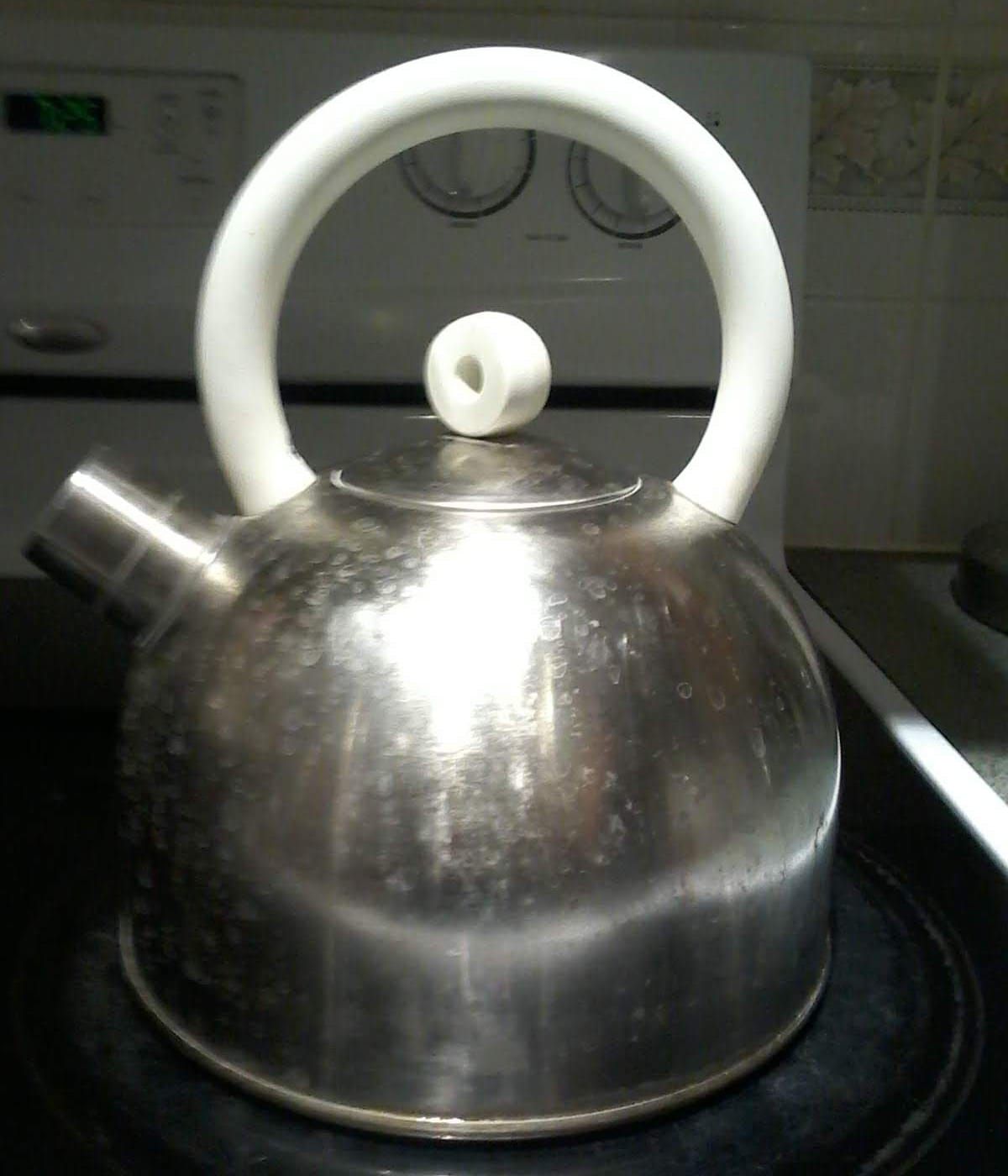
A kettle does one job: it holds water at 100°C, day after day, for years. That makes it one of the most heat-soaked pieces of plastic in most kitchens, and one of the easiest to replace. The catch is that “stainless steel kettle” on the box usually describes the body, not the lid, the seal, the window, the filter or the little probe that tells the kettle when to switch off. So we read the makers’ own pages, help centres and manuals for about 40 electric and stovetop kettles sold in the US, and asked one question of each: what touches the water and the steam?
Not one is fully plastic-free on what makers publish, if only because none of them says what the packaging is. A handful get close.
Kettles that meet our standard
Two kettles meet our standard, both stovetop and both plastic-minimal. In each, as far as the makers say, the water and steam meet only stainless steel. The plastic is in handles and knobs that sit outside the water. Each card links to a “Where the plastic is” box that names every part.
Meets our standard: plastic-minimal
V60 "Buono" Drip Kettle 1.2L (Silver, VKBR-120-HSV)
Hario
- Touches water or steam
- stainless steel
- Packaging
- Not disclosed by the maker (Hario says only that it ships in an "individual box").
Meets our standard: plastic-minimal
Pour Over Kettle 900ml (Mirror, 20364)
Kinto
- Touches water or steam
- stainless steel
- Packaging
- Not disclosed by the maker.
- Price
- $165 at Kinto USA (mirror finish) (checked November 17, 2026)
The two stovetop kettles are simple. Hario’s V60 Buono has a steel body and lid with a phenol-resin (hard plastic) handle and lid knob. Kinto’s 900 ml Pour Over Kettle has a steel body and lid with a nylon handle; we list only the plain mirror finish, because Kinto doesn’t say what the matt, white and black finishes are. Neither maker lists a whistle, a window or a filter, which is most of the point.
Kettles we’re still checking
Not yet confirmed
Stagg EKG Pro Electric Pour-Over Kettle 0.9L (Matte Black)
Fellow
- Touches water or steam
- 304 stainless steel, silicone, stainless steel, parts the maker doesn't describe (below); Matte black is a baked-on paint over the steel; Fellow doesn't say whether any is on the inside
- Packaging
- Not disclosed by the maker.
- Price
- $179.95 at Fellow (Pro, matte black) (checked November 17, 2026)
Not confirmed yet: What the steam passes through in the lid's vent (the lid is polypropylene), and whether the paint is only on the outside. We don't link it until that's confirmed.
Not yet confirmed
Corvo EKG Pro Electric Kettle 0.9L (Matte Black)
Fellow
- Touches water or steam
- 304 stainless steel, silicone, stainless steel, parts the maker doesn't describe (below); Matte black is a baked-on paint over the steel; Fellow doesn't say whether any is on the inside
- Packaging
- Not disclosed by the maker.
- Price
- $179.95 at Fellow (Pro, matte black) (checked November 17, 2026)
Not confirmed yet: What the steam passes through in the lid's vent (the lid is polypropylene), and whether the paint is only on the outside. We don't link it until that's confirmed.
Not yet confirmed
1.7L Stainless Steel Electric Kettle (SE152)
Cosori
- Touches water or steam
- 304 stainless steel, parts the maker doesn't describe (below)
- Packaging
- Not disclosed by the maker.
- Price
- $35.99 at Cosori (checked November 17, 2026)
Not confirmed yet: What seals the lid (it sits in the steam), and what the outer lid, handle and base are made of. We don't link it until that's confirmed.
The Fellow electric kettles came closest of the electric kettles. Fellow’s help centre lists what each part is made of, and admits its EKG kettles are “not fully plastic-free”. The inside is 304 stainless steel “with a compression-molded silicone ring around the temperature probe”, and the lid is polypropylene with a silicone gasket and a stainless steel underside. Two small, named silicone parts wouldn’t rule a kettle out at plastic-minimal. What stops us is the steam vent: Fellow’s own photos of the lid show a slot through the steel underside, and Fellow doesn’t say what the steam passes through on its way out of the polypropylene lid. There’s no plain steel version, either: Fellow says its matte kettles are “coated in an FDA, food-safe, high-temperature paint baked onto stainless steel” and its polished ones have a PVD coating, without saying whether any of it is inside.
Cosori’s $36 SE152 is the cheapest near-miss we found. Cosori says the interior, spout, inner lid and filter are all 304 stainless steel, which is more than most makers say, but not what seals the lid, and that seal sits in the steam. Smeg names the body, lid, spout and filter of its steel KLF03 as stainless steel, but not the water level indicator or any lid seal. It was also out of stock at Smeg’s US store when we checked (17 November 2026), so like the sold-out kettles below it has no card for now. Each card shows only what the maker says, with no link to buy, until the missing part is confirmed.
Two more stovetop kettles pass on what their makers publish but are sold out at the maker: Hario’s V60 Drip Kettle Wood and Kalita’s Wave 1-litre stainless kettle. We’ll look again when they’re back.
Why Saki isn’t here
Saki’s Luna Electric Kettle Pro is sold on being plastic-free. Its product page said, when we read it on 17 November 2026: “Laser-welded spout, no glue, no silicone. Every surface the water touches is stainless steel, which is why Luna is a true plastic-free kettle.” Saki’s own help article on the Luna’s materials says something different: the lid has a seal, “The Material: Heat-resistant, BPA-free Silicone. Where it is used: The ring around the edge of the lid.” It ends: “your water never touches anything but steel and the small silicone safety seal”.
To be fair to Saki, it discloses that seal more openly than most makers disclose anything, and its product page links to a third-party lab report. A small silicone seal wouldn’t rule a kettle out here. But our standard excludes a brand whose environmental claims contradict its own material disclosures, and “no silicone” next to a silicone seal is that.
What touches the water in a kettle
Start with the body, then look at everything else. In the kettles we read about, these are the parts that sit in the water or the steam, and the ones makers most often leave out:
- The underside of the lid. It sits in the steam for the whole boil and drips condensate back into the water. Fellow’s lids are polypropylene on top and steel underneath. Many makers don’t say.
- The lid seal. A ring around the lid stops steam escaping. It’s usually silicone, when anyone says. Cosori, Smeg and others name a steel lid but not what seals it.
- The water window. A strip you can see the water level through, with boiling water behind it. Makers call it a “water window” or “level indicator” and rarely say what it is.
- The filter. The mesh behind the spout that catches scale. Cosori and Smeg say theirs are steel.
- The temperature probe. Electric kettles with temperature control have a sensor in the water, and it has to be sealed into the wall. Fellow’s sits in a silicone ring. Hario’s US page for its electric Buono lists a “Thermostat Hood (located inside of kettle): Polypropylene” (read 17 November 2026), which is plastic in the water, so it fails.
- The whistle and spout cap. On a stovetop kettle, steam leaves through the whistle. Chantal’s page for its stainless steel Classic teakettle said on 17 November 2026: “Interior of the kettle is all Stainless Steel. No Plastic!” Chantal’s use-and-care sheet for its stainless steel teakettles says that on gas, “flames may rise up to the whistle and can melt the plastic whistle casing”. The sheet doesn’t say which models’ whistles have that casing.
One phrase is a giveaway: “BPA-free”. Steel doesn’t contain BPA, so a kettle with a “BPA-free stainless steel interior” (Hamilton Beach’s page for its 40851 kettle, read 17 November 2026) is telling you about some plastic, without saying where. For why “BPA-free” settles less than it sounds, see our bisphenols explainer.
Handles, outer knobs and bases are a different matter. Our standard allows rigid plastic you hold briefly, and plastic that never meets the water or steam, at plastic-minimal, as long as it’s named. Why we draw the line there, and why silicone is allowed only as a small named seal, is on our standards page; there’s more on silicone in our silicone explainer.
Electric or stovetop
Electric kettles are where the hidden parts pile up. Temperature control needs a probe in the water; a cordless kettle needs a base, a switch, usually a lid mechanism and often a window. Every one of those is a part the maker has to describe, and most don’t. Of the 22 electric kettles in our survey, none passed on today’s disclosures; the two Fellows came closest.
Stovetop kettles have fewer parts, so it’s easier to get to steel and nothing else. The trade-offs are practical, not chemical: they’re slower, they have no auto shut-off, and a kettle without a whistle needs watching. A whistle brings its own question, since it sits in the steam: the stovetop kettles we can list have no whistle at all.
Glass and enamel
Glass doesn’t shed plastic, but a glass kettle is rarely all glass: the electric ones sit on plastic bases with lids, seals and filters that, in the ones we looked at, makers didn’t fully describe. Glass has a quirk of its own. A Korean lab study looked into the “transparent and shiny needle-shaped” flakes that can appear when water is boiled repeatedly in a glass kettle. They turned out to be silicate minerals (hydrates of magnesium, calcium and aluminium silicate), not plastic. Soda-lime glass threw flakes after 24 hours above 90°C in slightly alkaline, calcium-rich water; borosilicate, the heat-resistant glass most kettles use, needed harsher, more alkaline conditions. The study made no health finding.
Enamel is glass fused onto steel or iron, and its question is lead and cadmium, which can be used in enamels and glazes. That’s why our standard won’t list enamel or glazed ceramic for food and drink without a published lead and cadmium statement (our glazes guide explains the risk). Of the three enamel kettle makers we checked, only Staub publishes one that covers its kettles: “Staub is Cadmium Free, Lead-Free, PFOA Free, PTFE Free, and PFAS Free.” We couldn’t find one on Le Creuset’s US site. Chantal says its ceramics are “lead and cadmium safe”, but we found no such statement for its enamel kettles. (Staub’s kettle still isn’t listed: Staub doesn’t say what its tea infuser or knob are made of.)
The only rule written for kettles that we found is Canada’s. Its Kettles Regulations, in force since 2016 and current as of November 2026, say a household kettle must not release more than 0.01 ppm lead into a litre of distilled water boiled for 15 minutes in total. When Health Canada checked in 2018–19, chemical testing of five products, including an enamel percolator and a stainless whistling kettle, found no compliance issues. Five products is a small check. We found no equivalent US rule for kettles.
What the studies found about plastic kettles
Two peer-reviewed studies have measured plastic coming off plastic kettles, and they agree on the shape of the problem.
The first, from Trinity College Dublin, ran plastic kettles for 100 days. They released microplastics, but the minerals in ordinary tap water changed the picture: after 40 days, every dissolved mineral the researchers tested (calcium and bicarbonate, as in hard water, plus copper and iron) cut release by more than 89% compared with pure lab water. The minerals form a thin film on the plastic, and the researchers found similar films forming in kettles in everyday use. That abstract gives no particle counts.
The second, from the University of Queensland, bought eight new polypropylene kettles from Brisbane supermarkets and boiled them up to 150 times, using a new method that identified the particles chemically as polypropylene. On the first boils, the kettles released on average 0.011 micrograms of nanoplastic and 0.032 micrograms of microplastic per square centimetre of plastic in contact with the water. After 150 boils, nanoplastic release had fallen by 96.36% compared with the first boil (to 0.0004 micrograms per square centimetre), and microplastic to 0.002. Hard tap water cut nanoplastic release significantly compared with pure water, as the Dublin study would predict.
You may have seen a much bigger number. The university’s press release said the first boil released “almost 12 million nanoparticles per millilitre”, almost 3 billion in a cup of tea. The paper itself gives its count per litre, not per millilitre, from a method its authors say “can overestimate”. We can’t tell which is right, so we’re not using either count.
Both studies point the same way: a new plastic kettle sheds the most, and use and hard water bring it down. Neither tested the plastic parts of “stainless” kettles, such as lids, windows and filters.
Nickel and other metals
Steel kettles have their own history. In a Danish survey published in 2000, 10 of 26 electric kettles released more than 50 micrograms of nickel per litre, a level chosen to protect people with nickel allergy; lead and chromium weren’t released in significant amounts. Makers changed their designs after talks with the Danish authorities, and the two kettles that still failed a follow-up were withdrawn. When Germany’s federal risk assessors tested 11 electric kettles in 2015, they found only a low release of the metals analysed. In the same study, the coffee machines released far more after descaling. We found no peer-reviewed kettle metal study since. For more on steel grades and nickel, see our stainless steel guide.
What to do
- Keeping a plastic kettle? Boil and tip out a few fills when it’s new. The Queensland authors write that rinsing before first use “does not achieve the same level of removal as repeated cycles of boiling and discarding”.
- When you replace it, look for steel where the water and steam are. The two stovetop kettles above are the ones we found that pass. Elsewhere, check the lid underside, seal, window, filter and probe, not just the body.
- Don’t descale a plastic kettle more than you need to. Our inference from the Dublin study: the mineral film that cut release is the same scale descaling removes. Rinse any kettle well after descaling.
- Read “BPA-free” as “contains plastic somewhere”. Then find out where.
- For enamel, ask for a lead and cadmium statement. If the maker won’t publish one, we won’t list it.
- Glass kettle forming shiny flakes? In the lab study they were mineral deposits that formed over long hot exposure, so descale it and don’t leave water standing hot in it for hours.
Where the evidence is weak
- Only two peer-reviewed studies of plastic kettles, both of kettles made almost entirely of polypropylene.
- No study of the plastic lids, windows, filters or seals in “stainless” kettles.
- No study of silicone kettle seals specifically. The nearest evidence, on silicone baby bottle teats and bakeware, is on our standards page.
- The particle count in the newer study is in doubt (per litre in the paper, per millilitre in the press release).
- No peer-reviewed study of metal release from kettles since 2015, and the nickel survey is from 2000.
- No study of lead or cadmium release from enamel kettles that we found.
- One lab study of glass flakes, with 24-hour exposures, and no health finding.
- Everything we say about products comes from what makers publish. We don’t test kettles.
Common questions
Is there a plastic-free kettle?
Not one we can confirm. No maker we read says what its packaging is made of, and most don’t describe every part that touches the water or steam. Two stovetop kettles meet our standard as plastic-minimal: steel where the water and steam are, with named plastic handles or knobs outside.
Are stainless steel electric kettles plastic-free inside?
Usually not, or the maker doesn’t say. The lid underside, lid seal, water window, filter and temperature probe are often plastic or silicone, or not described at all. Hario’s electric Buono, for example, lists a polypropylene thermostat hood inside the kettle.
Do plastic kettles release microplastics?
Yes, in two peer-reviewed studies. Release was highest from new kettles and fell steeply with use: in the Queensland study, nanoplastic release fell 96% after 150 boils, and in the Dublin study tap-water minerals cut release by more than 89%.
Is a glass kettle better than stainless steel?
The glass itself doesn’t shed plastic, but electric glass kettles have plastic bases and often undisclosed lids, seals and filters. Glass can also form mineral flakes with long hot exposure. Steel’s known problem was nickel: after a 2000 Danish survey, makers changed their designs and the worst kettles were withdrawn.
Are enamel kettles safe?
They can be, but enamel can contain lead and cadmium, so look for a published lead and cadmium statement. Of the three enamel kettle makers we checked, only Staub publishes one that covers its kettles.
Is a silicone seal a problem?
It’s a small part, and silicone isn’t a conventional plastic, but it isn’t inert either. We allow a small, named silicone seal only in plastic-minimal products. See our standards.
For how we judge products and claims, see our standards.
Sources
- Shi Y, Li D, Xiao L, Sheerin ED, Mullarkey D, Yang L, Bai X, Shvets IV, Boland JJ, Wang JJ (2022). The influence of drinking water constituents on the level of microplastic release from plastic kettles. Journal of Hazardous Materials.
- Shi K, Okoffo ED, Fu H, Bapp C, Jiang J, Rauert C, Thomas KV (2025). Release of nanoplastic from polypropylene kettles. npj Emerging Contaminants.
- University of Queensland (2025). Australians are drinking plastic particles in their tea, UQ research finds. UQ News (press release).
- Berg T, Petersen A, Pedersen GA, Petersen J, Madsen C (2000). The release of nickel and other trace elements from electric kettles and coffee machines. Food Additives and Contaminants.
- Müller FD, Hackethal C, Schmidt R, Kappenstein O, Pfaff K, Luch A (2015). Metal release from coffee machines and electric kettles. Food Additives & Contaminants Part A.
- Lee JE, Kim E, Hwang JB, Choi JC, Lee JK (2023). Flake formation and composition in soda-lime-silica and borosilicate glasses. Heliyon.
- Government of Canada (2016). Kettles Regulations (SOR/2016-181). Justice Laws Website.
- Health Canada (2019). Enforcement summary report: Kettles Regulations 2018-2019. Government of Canada (archived).
- Staub (Zwilling) (2026). Safety, testing and materials. staub.com/us.
- Fellow (2026). What materials do you use in your EKG kettles?. Fellow help centre (updated 6 October 2026).
- Fellow (2026). Why isn't my EKG kettle lid sitting correctly?. Fellow help centre (updated 22 October 2026).
- Fellow (2026). Why do you include Prop 65 warnings for some of your products?. Fellow help centre (updated 6 October 2026).
- Saki (2026). What materials are used in the Luna?. Saki help article.
- Chantal (2020). Chantal Stainless Steel Teakettle Use & Care (0120_StainlessSteelTKU&C). PDF linked from chantal.com/pages/product-use-care.
Spotted an error? Tell us and we'll correct it and note the change.