Shower curtains: PVC, PEVA, fabric and that new-curtain smell
What vinyl shower curtains release, what the much-quoted 2008 report did and didn't show, how PEVA and fabric compare, and why vinyl liners turn slimy.
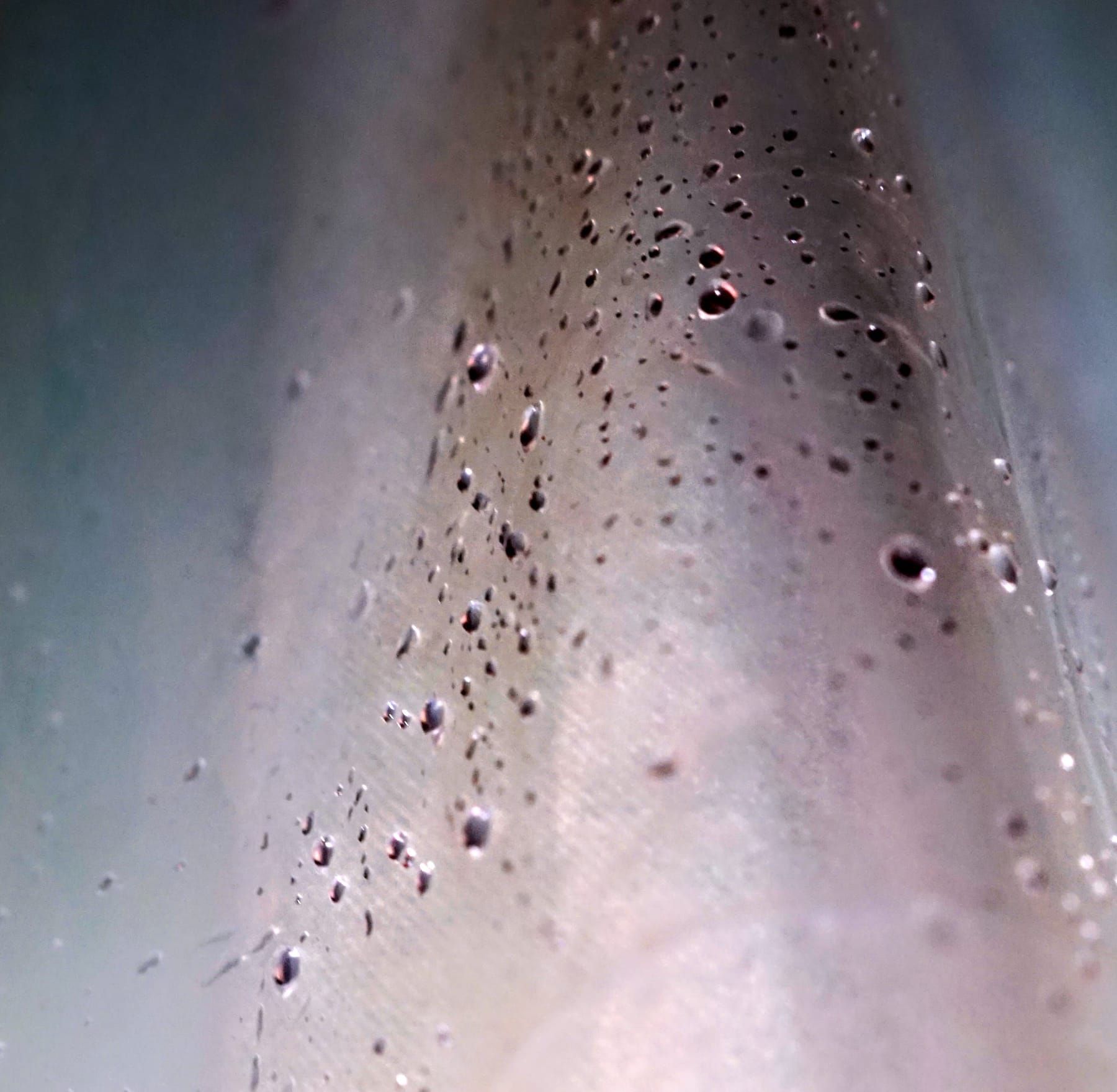
There’s a smell you only get from unwrapping a new shower curtain. It’s the smell of a soft plastic sheet letting go of some of what’s in it, in the smallest, dampest, worst-ventilated room in the house.
This piece is about shower curtains and liners: what they’re made of, what the testing found, what’s hype, and what to hang instead. For the rest of the bathroom (toothbrushes, floss, bottles), see our plastic-free bathroom guide.
What shower curtains are made of
Shop-bought curtains and liners mostly come in four kinds:
- PVC (vinyl). Cheap, waterproof, often clear or printed. PVC is hard and brittle on its own, so a floppy curtain needs a plasticiser, traditionally a phthalate. Our plastic codes guide explains PVC in detail.
- PEVA. Polyethylene vinyl acetate, sold as the chlorine-free alternative to vinyl. It’s still plastic, but it doesn’t need a phthalate to be soft.
- Polyester fabric. Usually treated to repel water, often used with a liner.
- Cotton, linen or hemp. Natural fabrics, sometimes woven tightly enough to work without a liner.
What vinyl curtains contain
The best-known test is a 2008 report by the Center for Health, Environment and Justice, a US environmental advocacy group. It had five PVC curtains from big US retailers analysed by an independent lab, Southwest Research Institute. Every one contained the phthalates DEHP and DINP, at 16% to 25% DEHP by weight in three curtains and 38% to 39% DINP in the other two. Three of the five contained organotins (tin compounds used as stabilisers), and each contained at least one of lead, cadmium, mercury or chromium.
In other words, up to two fifths of a vinyl curtain can be plasticiser. Phthalates aren’t chemically bonded to PVC, so they can move out over time. For what phthalates do in the body and how strong that evidence is, see our phthalates explainer.
These curtains went to the lab in September 2006. Formulations change, and in the EU the four most-studied phthalates (DEHP, DBP, BBP and DIBP) have been banned at 0.1% or more in the plasticised parts of consumer articles since 7 July 2020. That rule doesn’t cover DINP. As of November 2026, we found no US federal limit on phthalates in shower curtains.
The “108 chemicals” claim
The same report put one new PVC curtain, cut to scale, into a small test chamber for 28 days. Over that time it released 108 different volatile organic compounds, with toluene, cyclohexanone, MIBK, phenol and ethylbenzene at the highest levels. Seven were on the US EPA’s list of hazardous air pollutants.
That number gets repeated a lot. Here’s what it does and doesn’t tell you.
- It’s one curtain. The off-gassing test used a single curtain. In the separate content test, the first lab analysed VOCs in only one of the five curtains, because its levels saturated the equipment and risked damaging it.
- Most of it faded fast. The chamber held 40 VOCs at day 7, 16 at day 14, 11 at day 21 and 4 at day 28. “Some chemicals persisted for a month” is true. “108 chemicals for a month” isn’t.
- The comparison isn’t a health limit. Total VOCs were over 16 times the guideline levels set by the US Green Building Council and Washington State for indoor air, which are building-quality targets.
- Nobody measured people. The report didn’t measure exposure or health effects in anyone.
- It couldn’t see phthalates in the air. The chamber lab’s detection limit was too high, so every phthalate air sample came back below it. The test says nothing either way about phthalates escaping into the room.
- Real showers might be worse. The chamber was at room temperature and 50% humidity. The authors note that a hot, steamy bathroom would likely increase emissions, which is plausible but wasn’t tested.
- It’s an advocacy report. CHEJ campaigns against PVC, chose what to test and wrote up the results itself. It wasn’t peer reviewed. The report also describes earlier US EPA and Danish EPA work on vinyl curtains; we couldn’t open those studies, so we’re not relying on them.
Fair conclusion: new vinyl curtains do release a burst of solvents and other VOCs that falls off over weeks. That’s worth avoiding in a small room, and easy to avoid. It isn’t evidence that a shower curtain has made anyone ill.
Where the phthalates go
The longer-term issue is the plasticiser, not the smell. Phthalates leave soft vinyl slowly, and they turn up in house dust.
No study we found measured this for shower curtains specifically. The closest evidence is about other vinyl in the home. In Sweden, researchers found more DEHP and BBzP in children’s bedroom dust in homes with more PVC flooring and wall covering. They also found both phthalates in homes without any, because so much else is plasticised. A vinyl curtain is one small source among many. For phthalates, diet and fragranced products matter far more, as our explainer sets out. For dust in general, see our article on microplastics in dust and indoor air.
Bacteria may also help phthalates out. In a lab experiment, bacteria that feed on DEHP grew films on a PVC shower curtain, and DEHP leached into the surrounding water. That was a lab reactor, not a bathroom.
PEVA: better, but under-studied
PEVA doesn’t contain chlorine and isn’t plasticised with phthalates, which removes the two main complaints about vinyl. Beyond that, the evidence runs out. We found no independent, peer-reviewed study of what PEVA curtains release, so “non-toxic” on the packet is the seller’s claim, not a finding. PEVA is still a plastic sheet that goes in the bin at the end. If you need a liner, it’s the lesser plastic, and airing it out before you hang it costs nothing.
Mould and soap scum
All shower curtains get grimy, and the slimy film on a vinyl liner is alive. Researchers who analysed four household vinyl curtains found the “soap scum” was a lush, complex microbial biofilm, dominated by Sphingomonas and Methylobacterium. Both groups include opportunistic pathogens, bugs that rarely bother healthy people but can infect those with weak immune systems. The authors advised frequent cleaning or disposal of shower curtains, particularly in households with immune-compromised people.
“Disposal” is how most vinyl liners end up: grubby within months and binned. That’s the strongest practical argument for a curtain you can put in the washing machine.
Fabric curtains
A fabric curtain avoids the vinyl problem entirely, and you can wash it with towels instead of throwing it away.
- Polyester is the common choice. It isn’t vinyl, but it’s plastic fibre, and synthetic fabrics shed microfibres in the wash.
- Cotton, linen and hemp are the plastic-free options. Tightly woven ones can work without a liner if the curtain hangs inside the tub. They need washing and drying between uses so they don’t stay damp. We found no study comparing how fast mould grows on natural versus synthetic curtains.
Under our product standard, textiles more than 5% synthetic are disqualified, so a polyester curtain wouldn’t be listed, and a cotton, linen or hemp one could be. Check the hooks and rings too: they’re often plastic.
Bath mats
We looked for studies on bath mats and found nothing worth citing. Most are cotton, polyester microfibre or memory foam, often with a rubber or PVC non-slip backing. The same logic applies: natural fibres avoid microfibre shedding, a washable mat lasts longer than a foam one, and a bare cotton mat on a non-slip floor needs no plastic backing at all.
What to do
Ranked by evidence and effort:
- Skip vinyl. It’s the material with documented phthalates, metals and off-gassing (CHEJ), and the cheapest change is not buying it next time.
- Choose a washable fabric curtain, ideally cotton, linen or hemp. It replaces a string of disposable liners and keeps biofilm down (Kelley et al.).
- If you need a liner, pick PEVA over PVC and air it out first. Most VOCs from the vinyl curtain had dropped off within a few weeks (CHEJ). The same probably applies to PEVA, but that’s untested.
- Ventilate the bathroom. Run the fan or open a window during and after showers. That helps with any smell and with mould. It’s general good practice, not something these studies measured.
- Don’t panic about the old one. If you’ve had a vinyl curtain for months, the chamber test suggests most of the early burst of VOCs is over. Replace it when it’s grubby rather than binning it today.
More in our Home & bedroom section.
Sources
- Center for Health, Environment and Justice (CHEJ) (2008). Volatile Vinyl: The New Shower Curtain's Chemical Smell. CHEJ report (advocacy organisation; not peer reviewed).
- Kelley ST, Theisen U, Angenent LT, St Amand A, Pace NR (2004). Molecular analysis of shower curtain biofilm microbes. Applied and Environmental Microbiology.
- Latorre I, Hwang S, Sevillano M, Montalvo-Rodriguez R (2012). PVC biodeterioration and DEHP leaching by DEHP-degrading bacteria. International Biodeterioration & Biodegradation.
- Bornehag CG, Lundgren B, Weschler CJ, Sigsgaard T, Hagerhed-Engman L, Sundell J (2005). Phthalates in indoor dust and their association with building characteristics. Environmental Health Perspectives.
- European Commission (2018). Commission Regulation (EU) 2018/2005 amending Annex XVII to REACH as regards DEHP, DBP, BBP and DIBP. Official Journal of the European Union L 322.
Spotted an error? Tell us and we'll correct it and note the change.