Yoga and exercise mats: PVC, TPE, rubber, cork and what's in them
Most yoga mats are plastic or synthetic rubber. What consumer testers found in them, which materials avoid the worst of it, why natural rubber isn't automatically the safe pick, and how long a mat should last.
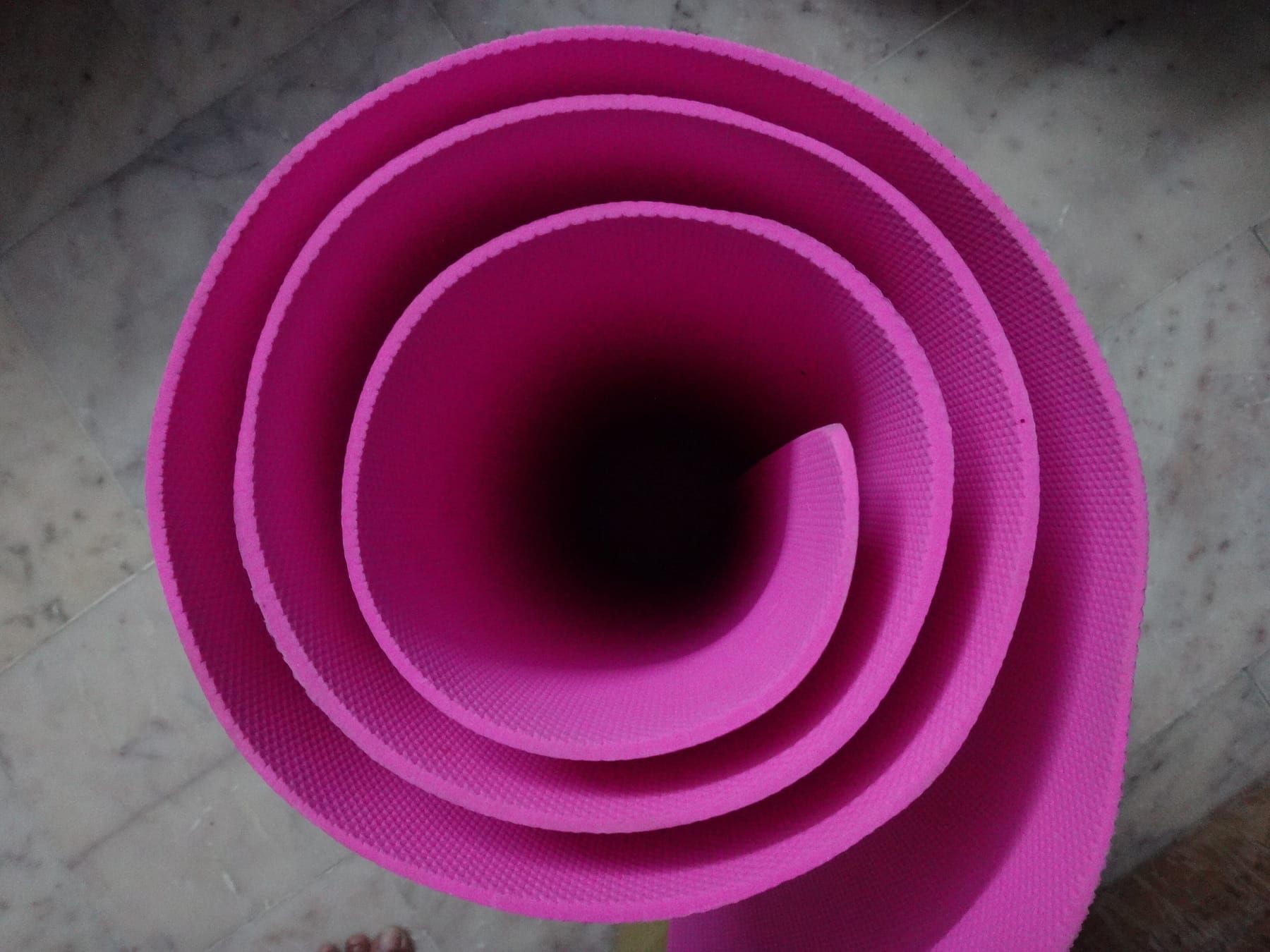
You lie on it, sweat into it, press your face into it in child’s pose and breathe right above it for an hour. A yoga mat is about as close as most adults get to a plastic product, apart from their clothes.
This piece covers yoga and exercise mats: what they’re made of, what independent testers have found in them, what each material trades off, and what our standards would ask of one.
What mats are made of
Most mats on sale are one of these:
- PVC (vinyl). The classic cheap, sticky mat. Soft PVC needs a plasticiser to bend. Our plastic codes guide covers PVC in more depth.
- TPE (thermoplastic elastomer). A broad family of rubbery plastics, sold as the “eco” step up from PVC. “TPE” alone doesn’t tell you the recipe.
- NBR (nitrile rubber). A synthetic rubber, used for thick, squashy exercise and Pilates mats.
- EVA foam. The material of interlocking floor tiles and many cheap gym mats.
- PU-coated rubber. A polyurethane top layer for grip, bonded to natural rubber. Two materials, one of them plastic.
- Natural rubber. From rubber trees, heavier and grippier. Not plastic, but not chemical-free either (more below).
- Cork. Usually a cork top layer on a rubber or TPE base. Check what the base is.
- Cotton and jute. Woven mats, traditional in India. Some jute mats are fibres bonded to a plastic layer, so read the spec.
What testers found
Three independent sets of tests give a reasonable picture. None measured anything in people.
Plasticisers in PVC
In 2020 the Danish Environmental Protection Agency bought soft PVC products online, including two yoga mats and two yoga balls. Both mats were plasticised mainly with DEHT, a non-phthalate plasticiser, at about 290,000 mg/kg, or 29% of the mat’s weight. Restricted phthalates were barely detectable, and lead and cadmium weren’t detected. The yoga balls were a different story: both contained the phthalate DIBP at 418,000 and 445,000 mg/kg, more than 40% of their weight. The EU has banned DIBP at 0.1% or more in consumer articles since July 2020, so the agency noted those balls couldn’t legally be sold in Denmark.
Two mats is a tiny sample. But it shows two things. Some PVC fitness gear bought online still contains banned phthalates in huge amounts. And a “phthalate-free” PVC mat can still be more than a quarter plasticiser, just a different one. For why swapping one plasticiser for another isn’t automatically progress, see the replacement problem in our phthalates explainer.
Formamide, naphthalene and other leftovers
Hong Kong’s Consumer Council published tests of 30 mats in February 2020. It found formamide, which the council describes as toxic to reproduction, in 28 of them, at 9 to 1,270 mg/kg, with nine above the 200 mg/kg cut-off the EU uses for toys. Those nine all passed the toy rules’ test for how much formamide gets into the air. Naphthalene, a PAH the council notes is classed as possibly carcinogenic to humans, turned up in nine mats, and three were above the German GS Mark’s 2 mg/kg limit for products in prolonged skin contact. The GS Mark is a voluntary German safety label, not law. One mat contained a little dibutyl phthalate, 0.017%, within the EU limit.
Denmark’s consumer council tested 14 plastic and natural rubber mats in late 2021. It rated six mats clean or nearly so, four with minor PAHs, and four poor: three because of naphthalene and one because of natural rubber (below). It found no significant phthalates or flame retardants. It also points out that the EU’s limit for PAHs in consumer products doesn’t cover naphthalene.
What this adds up to: mats can carry manufacturing leftovers, a minority at levels testers flag, and the rules don’t always cover them. Whether an hour on such a mat raises anyone’s risk hasn’t been studied. The Danish testers’ own view is that a mat isn’t a problem by itself but adds to your overall exposure.
Natural rubber isn’t automatically the safe pick
Natural rubber isn’t plastic, which is why it’s sold as the green option. Two catches.
Nitrosamines. Rubber can contain nitrosatable substances, which can turn into nitrosamines, and some nitrosamines cause cancer (THINK Chemicals). In the Danish test, one natural rubber mat released nitrosatable substances far above the limit set for balloons. There are no rules for these in yoga mats.
Latex allergy. A review estimated that latex allergy affects about 4.3% of the general population worldwide, with higher rates in healthcare workers. The Hong Kong council advises people sensitive to latex to avoid natural rubber mats. If you’ve reacted to rubber gloves or balloons, that includes you.
How long a mat lasts
We found no independent testing of how long mats last, so this is thin. The Hong Kong council’s advice is that PVC is cheaper but deforms and ages quickly, while rubber is heavier but durable. It also says not to machine wash or tumble dry mats.
What isn’t in doubt is that the plastic you don’t buy is the plastic you don’t throw away. A mat you use for ten years beats a “greener” one you replace every year. Before you bin a worn-out mat, cut it up for knee pads, drawer liners or under a plant pot first.
What our standard would require
Under our product standard:
- Plastic touching your skin for long periods is a disqualifier. PVC, TPE, NBR, EVA and PU-topped mats are all plastic or synthetic polymer on the surface you lie on, so we wouldn’t list them.
- Composition we can’t verify is a disqualifier, which rules out mats that just say “TPE” or “eco-material” without saying what’s in them.
- A cork or natural rubber mat could pass only if every layer is disclosed and plastic-free, including the base and any adhesive, and the packaging is plastic-free too.
- Cotton mats must be no more than 5% synthetic, like any textile we list.
Our standard doesn’t yet say anything about nitrosamines or latex in natural rubber. Until it does, if you’re latex-sensitive, choose cork on a non-latex base or a cotton mat.
What to do
Ranked by evidence and effort:
- Keep the mat you have and use it for years. No test above suggests binning an existing mat, and replacing it has its own footprint.
- When you buy, choose a material you can identify. Cork, cotton or natural rubber with full disclosure beat an unspecified “TPE”. Avoid PVC, especially cheap online PVC, where the Danish EPA found banned phthalates in fitness products.
- Air a new mat before using it. Both consumer councils recommend it: a few days, says Hong Kong, at least a week, says Denmark.
- Wash your hands after practice. The Hong Kong council suggests it, especially if naphthalene is a concern. It’s cheap insurance.
- Skip natural rubber if you’re latex-sensitive (Wu et al.).
What we can’t tell you is whether any of this matters for your health. The tests find chemicals; nobody has measured what reaches people who use mats. Treat these as precautions, not alarms.
More in our Home & bedroom section.
Sources
- Kastbjerg S, Rosborg P, Johannesen SA, Jacobsen E, et al. for the Danish Environmental Protection Agency (2020). Survey of unwanted additives in PVC products imported over the internet (Environmental Project No. 2149). Danish Environmental Protection Agency.
- Consumer Council, Hong Kong (2020). Harmful substances detected in yoga mats (CHOICE magazine issue 520 press release). Consumer Council press release, 17 February 2020.
- Forbrugerrådet Tænk Kemi (Danish Consumer Council THINK Chemicals) (2021). Test: chemicals in yoga mats. THINK Chemicals (taenk.dk), English summary.
- Wu M, McIntosh J, Liu J (2016). Current prevalence rate of latex allergy: why it remains a problem?. Journal of Occupational Health.
- European Commission (2018). Commission Regulation (EU) 2018/2005 amending Annex XVII to REACH as regards DEHP, DBP, BBP and DIBP. Official Journal of the European Union L 322.
Spotted an error? Tell us and we'll correct it and note the change.