What is plastic made of? From oil and gas to the chemicals in your lunchbox
Plastic is a chain of fossil-fuel building blocks plus a cocktail of added chemicals. How it's made, step by step, and why the additives are the part that matters for your health.
Ask what a yoghurt pot is made of and the honest answer is “mostly old fossil fuel, plus a list of extra chemicals nobody prints on the label”. That second part is the one worth caring about.
This guide walks through how plastic is made, from the ground to the shelf: the raw materials, the chemistry that strings them together, the main types, and the additives that come along for the ride.
What is plastic made of?
Every plastic has two parts. The first is a polymer: a very long molecule made by linking thousands of small, identical building blocks called monomers. The second is a mix of additives, chemicals blended in to make the material softer, tougher, coloured, fire-resistant or longer-lasting.
The Minderoo-Monaco Commission on Plastics and Human Health describes plastic as a carbon-based polymer backbone plus “thousands of additional chemicals” added for colour, flexibility, stability, water repellence, flame retardation and UV resistance. By weight, the polymer dominates. Across all the non-fibre plastic made since 1950, Geyer and colleagues estimated an average of 93% polymer and 7% additives. Seven percent sounds small until you remember how much plastic there is.
Where the raw materials come from
Almost all of it starts underground. According to the Minderoo-Monaco Commission, over 98% of plastics are produced from fossil carbon: coal, oil and gas. The OECD puts it more simply: most plastics in use today are virgin plastics, “made from crude oil or gas”.
The industry’s own figures tell the same story from a different angle. Plastics Europe, the European trade association, estimates that of 430.9 million tonnes of plastic made worldwide in 2024, 89.8% was fossil-based, 9.5% was mechanically recycled from consumer waste, 0.6% was bio-based or “bio-attributed” and 0.1% was chemically recycled. Those are preliminary estimates, and they leave out most synthetic fibres. The gap between “98%” and “89.8%” is mostly recycled plastic, which Plastics Europe counts separately even though it was fossil-based the first time round.
Which fossil fuel depends on where you are:
- Gas. In the United States, the Energy Information Administration says crude oil “is not the major source of feedstock for plastics production”. Plastics there come from natural gas, liquids separated out during gas processing (such as ethane) and feedstocks from oil refining.
- Oil. The main oil-based starting material is naphtha, a liquid refined from crude oil. The EIA lists ethane, propane and naphtha as the feedstocks for petrochemical crackers.
- Coal. China also uses coal. A 2024 study of China’s chemical industry found that, in 2017, 76% of its PVC was made via calcium carbide from coal, while its other plastics were mostly petrochemical.
If you want a precise world split between oil, gas and coal, we couldn’t find a trustworthy one. Even the EIA says it is unable to determine the specific amounts or origin of the feedstocks used for plastics in the US, because plants switch between them.
Plants supply a sliver. In OECD data for 2019, bioplastics made up 2.3 million tonnes of the roughly 460 million tonnes of plastic used worldwide, about 0.5%.
How is plastic made?
Turning a gas field into a lunchbox takes three broad steps.
Step 1: crack the fuel into small building blocks
Oil and gas are mixtures of hydrocarbons, molecules of carbon and hydrogen. To make plastic, they’re broken into smaller, more reactive molecules. Most of the key ones, ethylene and propylene, are made by steam cracking: heating hydrocarbons with steam until the molecules split apart. The ethylene that comes out is then used to make intermediate chemicals, “most of which are converted into plastics”.
Geyer and colleagues sum it up: “the vast majority of monomers used to make plastics, such as ethylene and propylene, are derived from fossil hydrocarbons”. In China, a coal route also exists, turning coal into methanol and then into olefins like ethylene and propylene, and it has increased coal use in the chemical sector.
Step 2: link the building blocks into chains
This is polymerisation, and it comes in two main kinds.
Addition (chain) polymerisation. Monomers snap onto the growing end of a chain one after another, like beads clipped onto a string. IUPAC, the body that defines chemistry’s terms, notes that this kind of growth usually happens without producing any small by-product molecules. Polyethylene is made by addition polymerisation of ethylene, and polypropylene by chain-growth polymerisation of propylene (also called propene).
Condensation polymerisation. Here two different building blocks react, and every time they join they give off a small molecule, often water. PET, the plastic used for drinks bottles, is made by condensation of ethylene glycol and terephthalic acid. Nylons are also made by condensation.
The difference matters mostly to chemists. For you, the useful point is that neither reaction is perfectly tidy: leftover monomers, catalysts, solvents and reaction by-products can remain in the finished material, and researchers count them among the chemicals present in plastic.
Step 3: add the extras, then shape it
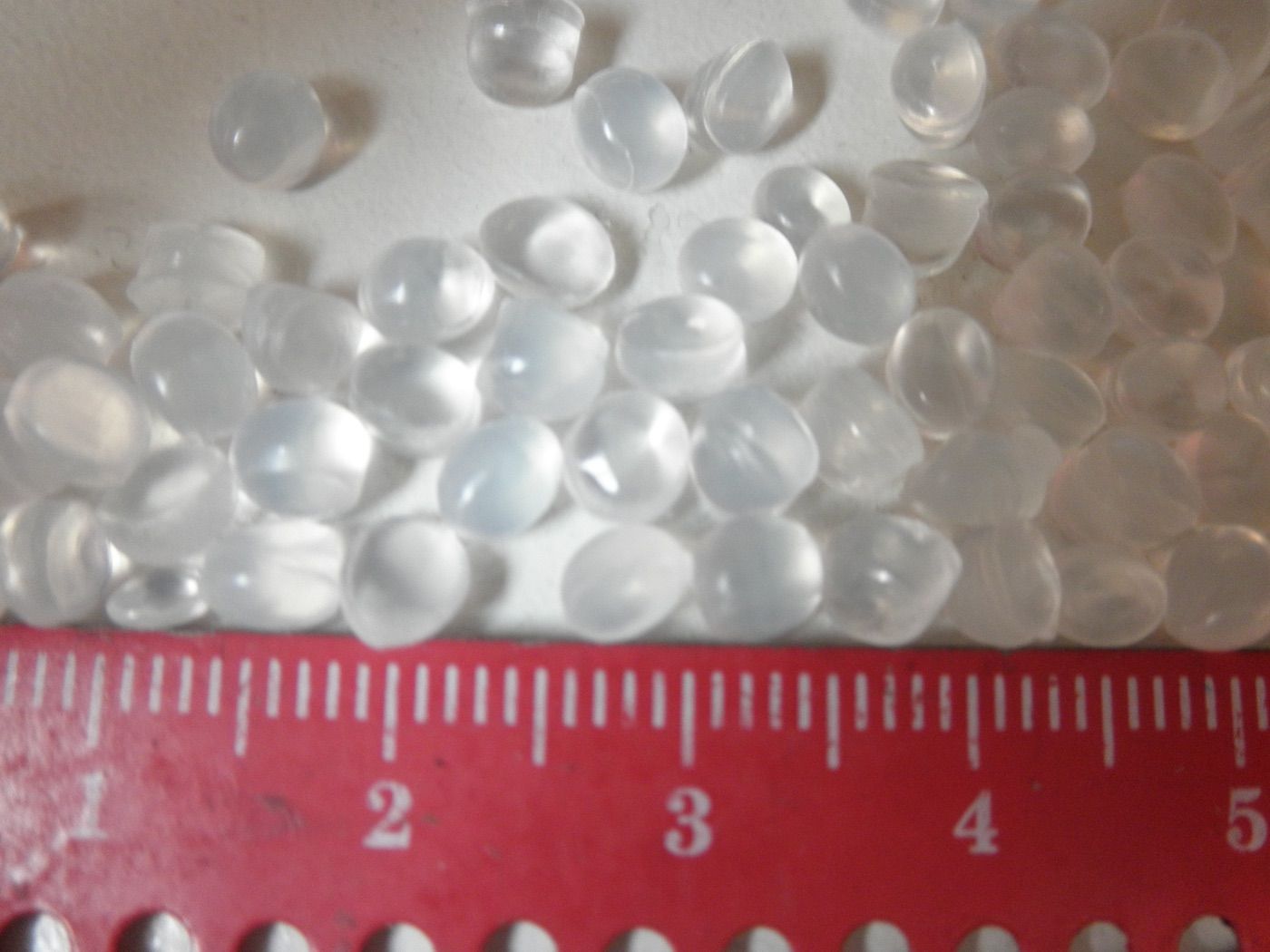
The raw polymer usually leaves the plant as small pellets, known as nurdles. Additives are blended in, and the mix is melted and shaped by extrusion, injection moulding, blow moulding or thermoforming into film, bottles, tubs, pipes and everything else.
The main types of plastic and what they’re for
A handful of polymers make up most of the world’s plastic. OECD estimates for 2019, out of about 460 million tonnes used worldwide:
| Plastic | Million tonnes used, 2019 | Familiar uses |
|---|---|---|
| Polyethylene (HDPE and LDPE together) | 109.8 | Bags, film, milk jugs, bottle caps |
| Polypropylene (PP) | 72.8 | Food tubs, yoghurt pots, bottle caps |
| Synthetic fibres (polyester, nylon, acrylic) | 60.4 | Clothes, carpets, upholstery |
| PVC | 51.4 | Pipes, window frames, flooring, cling film |
| PET | 24.9 | Drinks bottles, food trays |
| Polystyrene (PS) | 21.1 | Foam trays, cups, takeaway boxes |
| Polyurethane (PUR) | 18.0 | Mattress and sofa foam, insulation |
Each has its own chemistry problems: PVC needs plasticisers to be soft, polystyrene is built from styrene, and polycarbonate (in the “other” category) is made from BPA. Our guide to resin codes 1 to 7 goes through them one by one.
The additives
The polymer chain is only the skeleton. Additives give each product its personality:
- Plasticisers make rigid plastics soft and bendy. Phthalates are the best-known family.
- Flame retardants slow burning in electronics, foam and furniture. Some turn up where they shouldn’t, as our piece on black plastic utensils explains.
- Stabilisers and antioxidants stop plastic breaking down in heat and sunlight.
- Colourants and pigments.
- Fillers, cheap powders that bulk out the material.
Geyer and colleagues found that plasticisers, fillers and flame retardants account for about three-quarters of all additives by mass. UNEP’s 2023 technical report names ten groups of chemicals of major concern, including certain flame retardants and UV stabilisers, PFAS, phthalates, bisphenols, biocides and some metals.
How many chemicals are in plastic?
Thousands. The exact number depends on who’s counting and what they count:
- Wiesinger, Wang and Hellweg (2021) combed 63 industrial, scientific and regulatory sources for monomers, additives and processing aids. They identified more than 10,000 relevant substances, over 2,400 of them of potential concern because they met one or more EU criteria for persistence, bioaccumulation or toxicity.
- UNEP (2023) reported more than 13,000 chemicals associated with plastics and plastic production. Of about 7,000 with enough data to judge, more than 3,200 had at least one hazardous property of concern.
- Monclús and colleagues (2025), the peer-reviewed version of the 2024 PlastChem report, built an inventory of 16,325 known plastic chemicals. That includes 5,776 additives, 3,498 processing aids, 1,975 starting substances like monomers and 1,788 “non-intentionally added substances” such as impurities and by-products. They classed 4,219, about a quarter, as chemicals of concern.
Two more numbers from that last study stand out. Some 66% of the chemicals have no official hazard classification from regulators or industry, so nobody has formally assessed whether they’re hazardous. And only 6% are regulated under the global treaties the authors checked: the Basel, Stockholm and Minamata Conventions and the Montreal Protocol.
A chemical being “of concern” is a statement about hazard, not risk: it means the substance could cause harm, not that the amount in your water bottle does.
Why the additives don’t stay put
Here’s the key point. The polymer is one giant linked-up molecule, but most of what’s mixed into it isn’t locked in. The Monclús team noted that most plastic chemicals “are not covalently bound to the polymer”. They sit in the material like raisins in a cake, and they can work their way out.
The evidence for this is substantial. The same inventory found 1,572 chemicals shown to be released from plastics in migration experiments. For PET alone, it counted 472 chemicals of concern detected in the plastic, 143 of them with evidence of release, including into food.
This movement is called migration, and it speeds up with heat, fat and wear. That’s why our guides on BPA and other bisphenols and on microwaving plastic focus on what comes out of containers rather than the containers themselves.
What about bioplastics?
“Bioplastic” covers two separate ideas that labels love to blur. Bio-based means made from plants: bio-polyethylene, for example, is made from sugarcane or corn ethanol turned into ethylene, and it doesn’t biodegrade any more than the fossil version. Biodegradable means microbes can break it down under the right conditions, which isn’t the same thing. PLA, a common plant-based plastic, is made from lactic acid fermented from crops such as corn and sugarcane.
Bio-based plastics still need additives too. Our guide to compostable and plant-based plastics covers what the labels do and don’t promise.
What it means for you
Where plastic comes from matters for the climate and the planet. For your body, the more useful question is what plastic carries. The polymer chain is one huge molecule. The additives, leftover monomers and by-products are smaller and, because most aren’t bonded to the chain, free to move. And two-thirds of known plastic chemicals have never been formally classified for hazard.
You can’t see additives, and labels rarely list them. What you can control is contact: less plastic touching hot food, fatty food and children’s mouths. Our Start here page sets out the evidence-ranked basics, and the swaps guide shows where to begin.
Common questions
Is plastic made from oil?
Mostly from oil and gas, plus some coal. The Minderoo-Monaco Commission says over 98% of plastics come from fossil carbon. In the US, natural gas liquids such as ethane are the main feedstock, according to the EIA. A small share, about 0.5% in OECD data for 2019, is made from plants.
Who invented plastic?
The Science History Institute credits John Wesley Hyatt with the first synthetic polymer in 1869, celluloid, made by treating cellulose from cotton with camphor. Leo Baekeland invented Bakelite in 1907, the first fully synthetic plastic, containing no molecules found in nature.
Is plastic natural or synthetic?
Synthetic. Some natural materials, such as cellulose and rubber, are polymers too, but plastics are man-made polymers, nearly all of them built from fossil-fuel building blocks and blended with additives.
General information, not medical advice. Talk to a doctor about your own health, or your child's. More.
Sources
- Geyer R, Jambeck JR, Law KL (2017). Production, use, and fate of all plastics ever made. Science Advances.
- Landrigan PJ, Raps H, Cropper M, et al. (2023). The Minderoo-Monaco Commission on Plastics and Human Health. Annals of Global Health. Our summary
- OECD (2022). Plastic pollution is growing relentlessly as waste management and recycling fall short, says OECD (press release for the Global Plastics Outlook). OECD, 22 February 2022.
- OECD (2022). Global Plastics Outlook database: plastics use by polymer, 2019. OECD Data Explorer (SDMX dataflow DSD_PU@DF_PU).
- Plastics Europe (2025). Plastics the Fast Facts 2025. Plastics Europe (industry association), October 2025.
- US Energy Information Administration (2024). How much oil is used to make plastic? (FAQ). EIA, last reviewed 10 July 2024.
- US Energy Information Administration (2024). Hydrocarbon gas liquids explained: uses of hydrocarbon gas liquids. EIA Energy Explained.
- Amghizar I, Vandewalle LA, Van Geem KM, Marin GB (2017). New Trends in Olefin Production. Engineering.
- Jiang M, Cao Y, Liu C, Chen D, Zhou W, Wen Q, et al. (2024). Tracing fossil-based plastics, chemicals and fertilizers production in China. Nature Communications.
- IUPAC (2025). Chain polymerization (C00958), in Compendium of Chemical Terminology (Gold Book), 5th ed.. International Union of Pure and Applied Chemistry.
- IUPAC (2025). Condensation polymerization (C01237), in Compendium of Chemical Terminology (Gold Book), 5th ed.. International Union of Pure and Applied Chemistry.
- Khasru MA, Islam T, Sayam, Islam MS (2026). Environment and health impacts of synthetic food packaging: materials, synthesis, causes, and potential solutions. RSC Advances.
- Wiesinger H, Wang Z, Hellweg S (2021). Deep dive into plastic monomers, additives, and processing aids. Environmental Science & Technology.
- UNEP and Secretariat of the Basel, Rotterdam and Stockholm Conventions (2023). Chemicals in Plastics: A Technical Report. United Nations Environment Programme.
- Monclús L, Arp HPH, Groh KJ, Faltynkova A, Løseth ME, Muncke J, Wang Z, Wolf R, Zimmermann L, Wagner M (2025). Mapping the chemical complexity of plastics. Nature.
- Science History Institute (2023). History and Future of Plastics. Science History Institute.
Spotted an error? Tell us and we'll correct it and note the change.