Takeout and delivery containers: foam, black plastic and "compostable" bowls
Your dinner arrives in foam, black trays, clear tubs or a fibre bowl that may be greaseproofed with PFAS. What each one sheds, what the rules say in October 2026, and what to ask the restaurant.
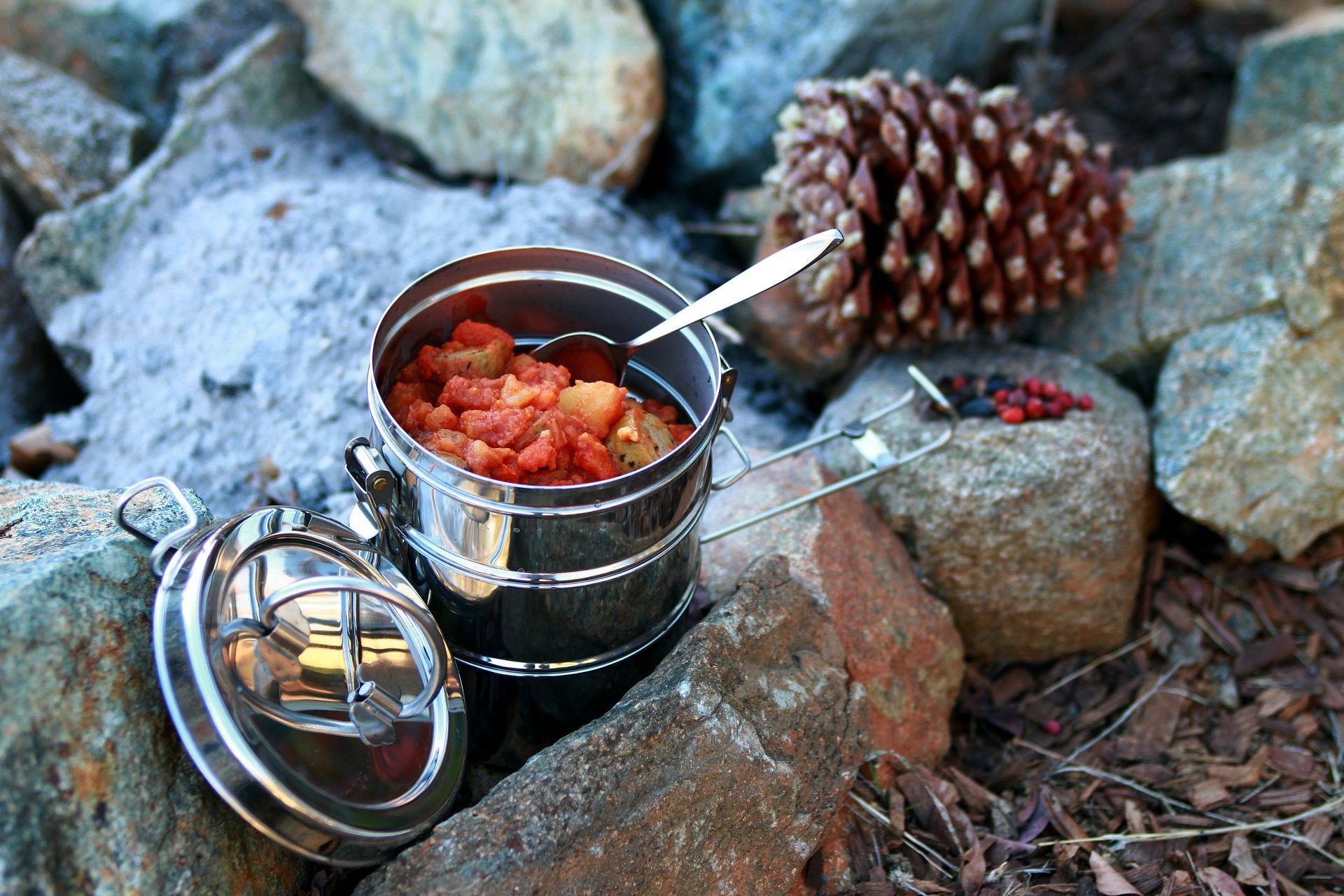
Takeout is plastic’s natural habitat. The food is hot, often oily, sometimes acidic, and it sits in a container designed to cost a few cents and be thrown away in twenty minutes. Delivery adds a bag, a lid, a sauce pot, a fork you didn’t ask for and a napkin wrapped in film.
None of this means your Friday curry is poisoning you. Nobody has shown that. But takeout is one of the few places where several of the stories we cover elsewhere collide: polystyrene, black plastic, PFAS “forever chemicals”, heat and fat. This guide sorts the containers by what’s actually known about them and ends with the questions worth asking the restaurant.
What your dinner arrives in
Roughly, from worst-reputation to best:
- Foam clamshells and cups (expanded polystyrene, resin #6). Banned in a growing list of places.
- Black plastic trays (often polystyrene or polypropylene, sometimes recycled electronics plastic).
- Clear tubs and lids (polypropylene #5 for the tub, PET #1 or polystyrene for clear lids).
- Plastic-lined paper: cups, noodle boxes and “paper” containers with a polyethylene or PLA lining.
- Moulded fibre (“bagasse”, sugarcane, bamboo or wheat-straw bowls and clamshells), sold as compostable.
- Aluminium trays, usually with a plastic-coated card lid.
The resin-by-resin chemistry is in our guide to plastic types #1 to #7. Here we focus on what’s specific to takeout.
Polystyrene foam: crumbly, rarely recycled, increasingly illegal
Foam is the takeout container with the worst record, for three reasons. It’s made from styrene, which the World Health Organization’s cancer agency classes as probably carcinogenic (mainly on evidence from workers and animals; the doses from food are far lower). It crumbles, so it breaks into persistent fragments in the environment. And almost nobody recycles it.
Particle tests point the same way. Chinese researchers found 3 to 29 microplastics per takeout container, with the most coming from rough-surfaced polystyrene. Only 30% of those particles matched the container’s own plastic, so some came from the air, not the tub. An Italian lab that agitated water in containers for 20 minutes found polystyrene released 1 particle at room temperature and 30 at 100°C. These are small counts from different methods, and the two studies disagree on heat: hot water made no difference in the Chinese study but increased polystyrene’s release in the Italian one.
Regulators have mostly moved on foam. The EU banned expanded polystyrene food and drink containers and cups from July 2021. In the US there is no federal rule, but Maryland, New York, Colorado, Washington, Oregon, California and Virginia have state bans, with exemptions such as raw meat trays. Washington’s statute, for example, has banned foam food containers, plates, clamshells and cups since 1 June 2024. If you still get foam, it’s worth asking why.
Black plastic trays
Black plastic is hard for recycling sorters to see, so some of it ends up made from old electronics casings that carried flame retardants. Sushi trays and black takeout bases are part of that story. We’ve covered it in depth, including the corrected 2024 study that went viral, in black plastic utensils and flame retardants. The short version for takeout: contamination is real but patchy, nobody has measured how much moves from a tray into food, and moving food to a plate before reheating costs nothing.
“Compostable” fibre bowls and PFAS
Here’s the twist. Many restaurants ditched plastic for moulded-fibre bowls to look greener. Plain plant fibre goes soggy with grease and sauce, and for years the cheap fix was to add PFAS, the fluorinated “forever chemicals”, to the pulp to make it oil- and water-repellent.
The evidence on this is strong:
- A 2017 study of about 400 US fast-food packaging samples found detectable fluorine in 46% of food contact papers and 20% of paperboard. Fluorine is a marker for PFAS.
- A 2023 Canadian study of 42 fast-food packages found the highest fluorine levels of all in moulded “compostable” bowls. Each of the eight high-fluorine samples analysed in detail held 4 to 15 individual PFAS. The authors called it “a regrettable substitution of single-use plastic food packaging”, which is scientist for “you made it worse.”
- The PFAS doesn’t stay in the bowl. Vermont researchers found that finished compost made with “compostable” serviceware from a large fair held 209–455 µg/kg of PFAS, including the carcinogen PFOA. Food waste from the same fair composted without the serviceware had none detectable in 2022. If the bowl goes to landfill instead, high-fluorine fibre packaging, including bagasse containers, released volatile PFAS in simulated landfill conditions.
How much gets into your food is less clear, and one recent study is reassuring. Chinese researchers tested 22 sugarcane-pulp tableware items in 2025. Total fluorine was above the EU’s 50 mg/kg trigger in 31% of products, and PFOA was above the EU’s single-substance limit in 9%. But most of the fluorine was inorganic rather than PFAS, and migration into food simulants was minimal, even after 12 hours at 50°C. So the bowl may be a bigger problem for compost, landfill and water than for the person eating from it. That’s still a problem.
Fibre has a non-PFAS quirk too. When sugarcane-pulp containers were tested with mild acid standing in for acidic food, the fibres broke down and released 36,400 to 231,700 microparticles per container, and overall migration exceeded the 10 mg/dm² limit for total transfer into food that the authors applied. Those particles were mostly plant fibre, not plastic, and their health relevance is unknown. Aluminium and iron were the main metals detected, with lead among the others.
Does any of this show up in people? In US national survey data, people who ate more of their calories at home had lower blood levels of all five PFAS measured, and restaurant and fast-food meals were generally linked to higher levels, though few of those links were statistically significant. The authors suggest less contact with food packaging as one explanation. It’s an association, not proof.
Where the rules stand (20 October 2026)
- United States. The FDA says manufacturers voluntarily stopped selling PFAS greaseproofing agents for food paper, and it declared 35 of those authorisations no longer effective from January 2025, with a June 2025 cut-off for old stock. That’s a voluntary exit plus paperwork, not a ban, and it doesn’t stop PFAS showing up as contamination in imported fibre. Several states go further. Oregon, for example, has banned the sale of foodware containers with intentionally added PFAS since 1 January 2025. California’s rules for anything labelled “compostable” are in our compostables explainer.
- European Union. Since 12 August 2026, food-contact packaging can’t be sold if it contains PFAS at or above 25 ppb for any single PFAS, 250 ppb for the sum, or 50 ppm for total PFAS. The broader story is in our PFAS explainer.
Heat, fat and time
The general rule from our microwaving guide applies double here: heat, fat and long contact are what move chemicals and particles out of plastic. Takeout containers weren’t designed to be reheated, and many carry no microwave claim at all.
The newer studies add some detail rather than a new verdict:
- In the Italian test, polypropylene tubs released no microplastics detectable under any condition, while PET and polystyrene released more at 100°C. One study, a handful of containers, water rather than food. But it supports a rough ranking: a clear PP tub beats a foam box or a PS lid.
- A Korean lab found that paper food containers lined with PLA, the “plant-based” plastic, released far more nanoplastics in the microwave than ones lined with polyethylene, up to 40,000 times more depending on cooking time. Higher microwave power increased release. “Compostable lining” is not the same as “microwave-friendly”.
The cheapest intervention in this whole article: when the food arrives, put it on a plate or in your own glass or steel container. If you’re keeping leftovers, don’t store and reheat them in the takeout tub.
Does it make people ill?
We don’t know, and the one study that tried to link takeout containers to disease is weak. A Chinese team surveyed 3,179 people and found that those reporting frequent exposure to plastics had slightly higher odds of congestive heart failure, an odds ratio of 1.13. They then fed rats water that had been boiled in takeout containers and saw gut and heart-tissue changes. A self-reported, cross-sectional survey can’t separate containers from everything else about people who eat a lot of takeout, and rat results don’t translate directly to people. We’d treat it as a reason for more research, not a finding. The best-evidenced takeout exposures are still the ones in the food itself, such as the phthalates from food-handling gloves described in our microwaving guide.
Delivery adds a layer
Delivery means more packaging per meal: bags, sealed lids, separate sauce pots, cutlery packs. A small Chinese study, based on a survey of only 45 people, estimated that 86% of the carbon footprint of a delivery order (excluding the food itself) came from the packaging, and that walking to restaurants under a kilometre away could cut 68% of it. Treat the numbers as rough. The direction is intuitive: collecting it yourself, in your own container, removes most of the extras.
Some places have already made the extras opt-in. In Washington State, since 1 January 2022, restaurants may hand out utensils, straws, condiment packets and some drink lids only after the customer says they want them. Wherever you live, the “no cutlery” box in the delivery app is worth ticking.
Can you bring your own container?
This is where the law differs most between places.
European Union. From 12 February 2027, every takeaway business that sells drinks or ready-prepared food in takeaway packaging must offer a system for customers to bring their own container, at no higher price and on no less favourable terms than single-use, and must put up a sign saying so. From 12 February 2028, they must also offer the option of reusable packaging within a reuse system; micro-enterprises are exempt from that second duty. Businesses can refuse a container they consider unhygienic or unsuitable, and they carry no liability for food-safety problems caused by the customer’s container. From 2030, single-use plastic packaging for food eaten on the premises is banned.
United States. Food safety rules are set by states and local health departments, most of which adopt some version of the FDA’s model Food Code, often years after it’s published. The 2026 edition now lets staff or customers refill consumer-owned containers with food if the container is made for reuse, has been cleaned and sanitised, and is checked by an employee, and if it’s filled in a way that can’t contaminate the restaurant’s surfaces. The 2022 edition, which many places still follow, spelled out that permission only for consumer-owned drinks containers, so a restaurant’s “no” may be an older local code or its health inspector’s caution rather than its own choice. Some states have written their own rules allowing it: California lets restaurants fill clean customer-owned containers if they keep them away from the serving surface or sanitise it after each fill. Ask, and if the answer is no, ask whether it’s a local health rule.
Practical tips that help a restaurant say yes: a clean, dry, lidded container with no food residue; hand it over open so staff don’t have to touch your lid; and accept that they may plate the food onto their own dish and slide it in rather than putting their serving spoon in your box.
What to ask the restaurant
Short, polite and specific works better than a lecture:
- “Can I bring my own container next time?” In the EU from February 2027, the answer must be yes.
- “Are your fibre bowls PFAS-free?” A supplier who has checked will have a PFAS-free statement or a total-fluorine test. If they don’t know, that tells you something too.
- “Could you leave out the cutlery, napkins and sauce pots?”
- “Do you still use foam?” If you’re in a state or country that bans it, they shouldn’t.
- “Do you offer a reusable container scheme?” Some cities have deposit-based reusable takeout schemes. Using them is the closest thing to a systemic fix you can do from the queue.
What to do, ranked by evidence
1. Move hot food out of plastic and foam as soon as it arrives (good evidence that heat increases release; health effect unproven). Plate it, and reheat leftovers in glass or ceramic. It costs nothing and sidesteps the container question entirely.
2. Bring your own container where it’s allowed (strong logic, little direct study). Reuse removes the single-use container, its chemistry and its waste in one go. In the EU it becomes a right in February 2027. Steel and glass containers are what our product standard favours; a plastic box you already own is still better than a new disposable each time.
3. Avoid foam (moderate evidence). It sheds the most in several tests, carries styrene and is rarely recycled. Where it’s banned, report it.
4. Ask about PFAS in fibre bowls (strong evidence PFAS has been used; weaker evidence on how much reaches food). The clearest harm is downstream, in compost, landfill gas and water. Don’t put “compostable” fibre in your home compost unless it’s certified PFAS-free.
5. Skip the extras and collect when you can (moderate evidence, mostly about waste and carbon). Tick “no cutlery”, refuse the sauce pots you won’t use, walk to the place around the corner.
6. Don’t panic about the occasional takeaway (honest uncertainty). Particle counts from containers are small next to other sources, and the one study linking takeout plastic to heart disease is weak. Your exposure is a function of how often, how hot and how fatty. Change the habit, not the menu.
The bigger lever isn’t in your kitchen. Foam bans, PFAS limits and the EU’s bring-your-own rule all happened because people pushed for them, not because diners chose better clamshells. Where those rules don’t exist yet, that’s the ask.
More in our on-the-go section.
Sources
- Schwartz-Narbonne H, Xia C, Shalin A, Whitehead HD, Yang D, Peaslee GF, Wang Z, Wu Y, Peng H, Blum A, Venier M, Diamond ML (2023). Per- and polyfluoroalkyl substances in Canadian fast food packaging. Environmental Science & Technology Letters.
- Schaider LA, Balan SA, Blum A, Andrews DQ, Strynar MJ, et al. (2017). Fluorinated compounds in U.S. fast food packaging. Environmental Science & Technology Letters.
- Goossen CP, Schattman RE, MacRae JD (2023). Evidence of compost contamination with per- and polyfluoroalkyl substances (PFAS) from "compostable" food serviceware. Biointerphases.
- Ye Y, Titaley IA, Kim-Fu ML, Moll AR, Field JA, Barlaz MA (2024). Release of volatile per- and polyfluoroalkyl substances from plant fiber-based food packaging and municipal solid waste to gas under simulated landfill conditions. Environmental Science & Technology.
- Chen L, Hu C, Wang Z (2025). Migration safety of perfluoroalkyl substances from sugarcane pulp tableware: residue analysis and takeout simulation study. Molecules.
- Hu Y, Mo CR, Wang ZW, Yu WW, Hu CY (2023). Sugarcane pulp take-out containers produce more microparticles in acidic foods. Foods.
- Susmann HP, Schaider LA, Rodgers KM, Rudel RA (2019). Dietary habits related to food packaging and population exposure to PFASs. Environmental Health Perspectives.
- US Food and Drug Administration (2025). FDA determines authorization for 35 food contact notifications related to PFAS are no longer effective. FDA Human Foods Program constituent update, 3 January 2025.
- Oregon Department of Environmental Quality (2024). Foodware containers and polystyrene foam (SB 543 fact sheet). Oregon DEQ.
- European Parliament and Council (2025). Regulation (EU) 2025/40 on packaging and packaging waste. Official Journal of the European Union.
- IARC Working Group on the Evaluation of Carcinogenic Risks to Humans (2019). Styrene, styrene-7,8-oxide, and quinoline (IARC Monographs volume 121). International Agency for Research on Cancer.
- European Parliament and Council (2019). Directive (EU) 2019/904 on the reduction of the impact of certain plastic products on the environment. Official Journal of the European Union.
- US Food and Drug Administration (2022). Food Code 2022. US Public Health Service / FDA.
- US Food and Drug Administration (2026). Food Code 2026. US Public Health Service / FDA.
- California Legislature (2026). Health and Safety Code section 114121 (California Retail Food Code: returnables, cleaning for refilling). California Health and Safety Code.
- Washington State Legislature (2021). RCW 70A.245.070 (expanded polystyrene) and 70A.245.080 (optional serviceware). Revised Code of Washington.
- Caponigro V, Di Fiore C, Carriera F, Iannone A, Malinconico A, Campiglia P, Crescenzi C, Avino P (2025). Evaluating microplastic emission from takeaway containers: a micro-Raman approach across diverse exposure scenarios. Food Chemistry.
- Du F, Cai H, Zhang Q, Chen Q, Shi H (2020). Microplastics in take-out food containers. Journal of Hazardous Materials.
- Son JW, Nam Y, Kim C (2024). Nanoplastics from disposable paper cups and microwavable food containers. Journal of Hazardous Materials.
- Wu Y, Li Z, Shi L, Zhu Y, Wang Y, Yan N, Yang Y, He S, Li J (2024). Effects of leachate from disposable plastic takeout containers on the cardiovascular system after thermal contact. Ecotoxicology and Environmental Safety.
- Xie J, Xu Y, Li H (2021). Environmental impact of express food delivery in China: the role of personal consumption choice. Environment, Development and Sustainability.
Spotted an error? Tell us and we'll correct it and note the change.