Do water filters and boiling remove microplastics? What the tests show
Boiling hard water works better than you'd think. Many filters work worse. What peer-reviewed tests show, what 'certified for microplastics' means, and why PFAS is the better reason to filter.
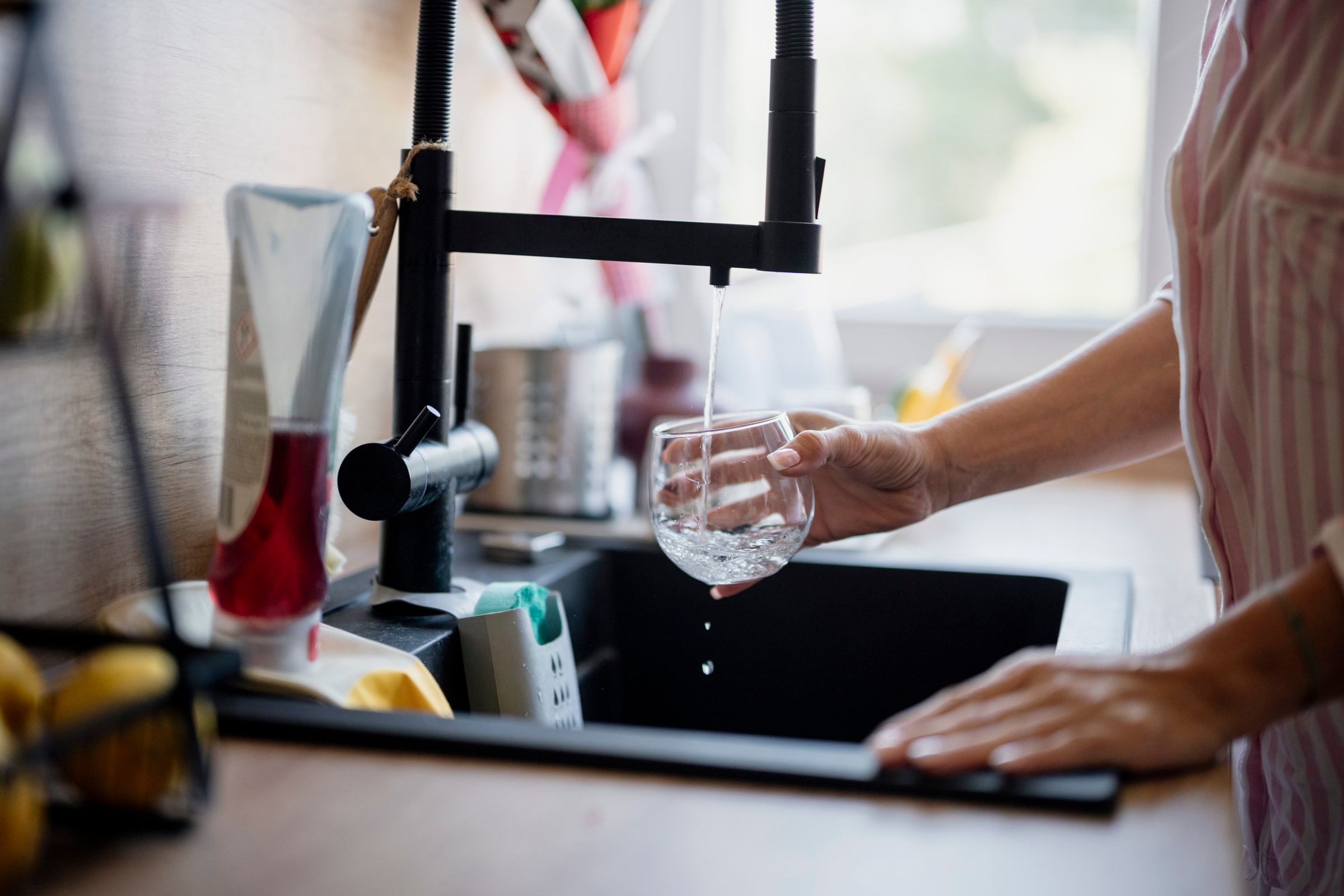
Here’s an awkward fact for the water filter industry. One of the best-supported ways to strip microplastics out of tap water costs nothing and needs only a kettle. Meanwhile, some of the plastic filters sold to protect you from plastic have been caught adding plastic particles to the water.
That doesn’t mean filters are useless. It means “removes microplastics” on a box tells you very little. Here’s what the tests show, what the certifications cover, and where your money does the most good.
First: how much plastic is in tap water?
Less than in bottled water. We covered the bottled-versus-tap evidence in detail in Bottled water: you’re paying extra for the plastic, so here’s just the part that matters for filtering.
Municipal treatment already does the heavy lifting. A University of Toronto team sampled ten treatment plants across southern Ontario and found they removed more than 97.5% of microplastics larger than 2 micrometres, from source water that held 1,193 to 7,185 particles per litre. That’s a big cut, but it says nothing about particles smaller than 2 micrometres, which the study didn’t count.
What reaches your glass can also pick up plastic on the way. In Milan, household taps averaged 1.9 particles per litre, and only 8% of all the particles found were plastic; most were cellulose. Levels were higher and more variable inside private homes than in the mains. The authors suggest the building’s own plumbing may be a source. That’s from ten homes, so treat it as a lead, not a verdict.
So the question isn’t “how do I make toxic water safe?” It’s “how do I take out the last bit, and does the gadget actually do that?”
Boiling: the free option that has evidence
Boiling sounds like folk wisdom. For hard water, it holds up.
In a 2024 study, researchers in China found that when hard tap water boils, the calcium carbonate that forms limescale grows on and around plastic particles, trapping them in crusty clumps. Boiling hard water (more than 120 mg of calcium carbonate per litre) removed at least 80% of polystyrene, polyethylene and polypropylene particles between 0.1 and 150 micrometres. That size range reaches down into nanoplastics, which most filter tests never look at.
The result has since been replicated in real-world water. A 2026 study in Khulna, Bangladesh, tested 45 samples from piped supply, ponds and groundwater. Boiling cut microplastic counts by more than 70% across all three water types, and the bigger cuts went with harder water (correlation r = 0.76). The authors credit the same mechanism: limescale dragging particles to the bottom, not heat destroying them.
Three catches, and they matter:
- It’s a hard-water trick. The 80% figure applies to hard water. The original paper’s abstract makes no promise for soft water, and the Bangladesh team found that removal rose with hardness. If your kettle never furs up, expect less.
- The plastic doesn’t vanish. It sinks. The Bangladesh authors recommend letting boiled water cool and settle, then gently pouring off the clear water and leaving the sludge behind. Swirling the whole kettle into your mug undoes the point.
- Boil in something that isn’t plastic. A 100-day study found plastic kettles released microplastics into the water, and hot polypropylene sheds heavily, as the baby bottle research shows. A steel or glass kettle is the sensible precaution.
Also: hot water that you then chill in the fridge is a faff, and boiling burns energy. This is a good habit for tea and cooking water in hard-water areas, not a household water supply.
Filters: what the peer-reviewed tests found
The peer-reviewed evidence on home filters and microplastics is thin. There are a handful of studies and lots of marketing. Here’s what exists.
Pitchers: a membrane matters, carbon alone doesn’t
The most useful study comes from the same Toronto drinking-water lab. In 2023, it tested three pour-through pitchers from major North American retailers. All three met NSF/ANSI 42 and 53, the standard certifications for taste, odour, lead and other contaminants. The team spiked tap water with PET and PVC fragments and nylon fibres (30 to 1,000 micrometres) and ran each cartridge past its rated life.
- Carbon plus ion exchange, no membrane: poor. At some points in the cartridge’s life, more PET and PVC fragments came out than went in. The authors think the filter was trapping particles and later releasing them. It did catch most of the long nylon fibres.
- Carbon plus a membrane: much better. The device with the tightest membrane (0.2 micrometres) performed best, and the authors’ conclusion is that 95–100% removal is achievable with a physical barrier. Even so, some microplastics showed up after the membranes, possibly through flaws in the membrane surface.
The authors’ bottom line: carbon and ion exchange are designed to grab dissolved chemicals, not physically sieve out particles. Devices certified under health-based standards may still not remove microplastics.
Two limits: three devices is a small sample, and the smallest particles tested were tens of micrometres across. Nanoplastics weren’t in the test.
An independent test found the same pattern
ConsumerLab, a subscription testing company, ran four popular pitchers (Aquasana, Brita, PUR and ZeroWater) on tap water containing 33.5 microplastic particles per litre. According to its free summary, one removed all detectable particles and two cut them by 80% and 36%. One raised the count to 437.4 particles per litre, and still added plastic after extra flushes. The public summary doesn’t say which brand that was or how the particles were counted, and this isn’t peer-reviewed. But it lines up with the Toronto result: some pitchers make things worse.
Under-sink and reverse osmosis: strong in theory, untested in kitchens
Reverse osmosis (RO) pushes water through a membrane fine enough to hold back dissolved salts. Plastic particles are huge by comparison. Reviews of membrane treatment report that microfiltration, ultrafiltration, nanofiltration and RO can achieve removals of up to 100%. And in the Ontario plant study, facilities using ultrafiltration membranes removed significantly more plastic than conventional ones (Balkenbusch et al.).
Here’s the honest gap. We found no peer-reviewed study testing household RO units against microplastics or nanoplastics in real homes. The “removes 99.9%” figures you’ll see online come from manufacturers or blogs, not from independent measurement of the thing under your sink. Solid carbon blocks, which have finer pores than loose carbon granules, are in the same position: plausible, not properly tested for microplastics.
The irony: filters made of plastic
Almost every home filter is a plastic housing around a cartridge that often contains plastic parts or plastic fibre media. You’re pushing water through plastic to get the plastic out.
That’s not just a gotcha. In Dogonbadan, Iran, researchers took 90 samples from the inlets and outlets of home water treatment units. Water coming out averaged 20 microplastics per litre versus 11.66 going in, and the most common polymers were polycarbonate and polypropylene. Those are the plastics commonly used for filter housings and cartridges, though the study doesn’t prove the particles came from the units. The abstract doesn’t name the technology, but the side effects the authors list are typical of reverse osmosis: demineralised water, lost fluoride, and wasted water. Their verdict: the units weren’t worth using there.
Put that next to the Toronto pitcher that released fragments, and ConsumerLab’s pitcher that added particles, and a rule emerges. A filter is only as good as its last cartridge change. Old cartridges can dump what they’ve caught. New ones may shed. Flush new cartridges as instructed, change them on schedule (the Toronto study’s carbon pitchers were rated for 150 litres, or about two months), and don’t run them into the ground.
What “certified for microplastics” actually means
There is one recognised certification claim for microplastics in home filters, and it’s narrower than it sounds.
NSF/ANSI 401, the standard for “emerging” contaminants, gained a microplastics reduction claim, which NSF staff announced in early 2022. To pass, a filter must cut particles between 0.5 and 1 micrometre by 85%. The test borrows the NSF/ANSI 42 “Class I particulate” method, so the two can be certified together. And the challenge particles are derived from ISO fine test dust, a standardised mineral dust, not plastic. NSF’s own staff describe that as a “conservative surrogate”: if a filter can stop tiny dust, it should stop bigger plastic.
That logic is reasonable for microplastics, which are defined as roughly 1 to 5,000 micrometres. It tells you nothing about nanoplastics, which are smaller than the test particles. It also doesn’t test whether the filter itself sheds plastic.
What about the other standards?
- NSF/ANSI 42 covers taste, odour and chlorine, plus optional particulate classes. A Class I particulate claim is the same test as the microplastics claim, just without the word “microplastics” on the box.
- NSF/ANSI 53 covers health contaminants like lead, including particulate lead, plus PFAS claims. And the Toronto study showed a 42- and 53-certified carbon pitcher failing on microplastics.
- NSF/ANSI 58 covers reverse osmosis systems. It carries PFAS claims. NSF’s own descriptions tie the microplastics claim to 401 and 42, and we found no microplastics claim under 53 or 58.
So if microplastics are your concern, look for the specific NSF/ANSI 401 microplastics claim (or 42 Class I particulate) on the certifier’s listing, not just “NSF certified” on the box. Then remember it’s a dust test.
The better reason to filter: PFAS
If you want a filter, the strongest evidence isn’t about plastic particles. It’s about PFAS, the “forever chemicals” used in non-stick and water-repellent coatings and firefighting foam. Unlike microplastics, these have enforceable US drinking water limits, at least for now.
In 2024 the EPA set limits for PFOA and PFOS at 4.0 parts per trillion, with utilities due to comply by April 2029. In May 2026 the agency proposed letting systems that ask push that to April 2031, and separately proposed scrapping the limits for four other PFAS, including GenX. As of mid-October 2026, both are still proposals. If your utility now has two extra years before it has to act, a home filter matters more.
Here the evidence is better:
- Under-sink RO and two-stage filters were the clear winners. Researchers tested filters in 73 North Carolina homes. All under-sink dual-stage and RO systems showed near-complete removal of every PFAS tested. Pitchers, faucet filters, fridge filters and single carbon blocks were variable: about 60–70% removal of long-chain PFAS and about 40% of short-chain ones.
- Whole-house carbon systems backfired. In four of the eight tested, PFAS levels in the filtered water went up.
- New pitchers can do well. In a 2026 London study, five filter jugs removed on average 92–99% of 38 PFAS spiked into clean lab water, and the best one showed no drop in performance over 100 litres of tap water. The same study found London tap water already under England’s lowest PFAS action threshold in all 210 samples.
Why do the pitcher results differ so much? The London jugs were new and tested in clean lab water; the North Carolina filters were in real use, at whatever stage of their cartridge life. That’s our reading, not either team’s finding, but it lands on the same rule as above: change the cartridge.
On certification, check the details. NSF/ANSI 53 and 58 have long had a claim for reducing PFOA and PFOS to 70 parts per trillion, far above the EPA’s 4.0, and many products were still certified to that older version as of mid-2025. Newer versions add a “total PFAS” claim with much lower targets. Look for that one.
Regulators haven’t caught up on microplastics
There’s no enforceable limit on microplastics in US drinking water. EPA’s 2026 draft Contaminant Candidate List includes microplastics as a group. That’s the list of contaminants the agency is considering for possible future regulation, a first step that often goes nowhere for years. California’s monitoring effort is covered in our bottled water piece.
Meanwhile, the health question is still open. Plastic is turning up in human tissue, but no study has shown that the levels in drinking water cause disease. We cover what is and isn’t known in Microplastics are inside you right now. That uncertainty is a reason for cheap precautions, not for panic-buying a gadget.
What to actually do, ranked by evidence and cost
- Drink tap water, not bottled. It’s the cheapest move and the best-supported one. Treatment plants already strip out more than 97.5% of microplastics above 2 micrometres, and bottled water adds its own plastic (details here).
- If your water is hard, boil, settle and decant. It’s free if you’re boiling anyway, and two independent studies support it (Yu et al.; Nupur et al.). Use a steel or glass kettle, and leave the scale behind. Less benefit with soft water.
- If you’re buying a filter anyway, buy it for PFAS, and buy the right one. Under-sink RO or two-stage systems have the strongest evidence for PFAS. They’re the most expensive option, need regular cartridge and membrane changes, and RO wastes water. Check that the certification is the current total-PFAS claim, not just the old 70 ppt one. Check your utility’s water quality report first; if PFAS isn’t detected, you may not need this.
- If you want a pitcher for microplastics, pick one with a membrane. Carbon-only pitchers had the weakest results and sometimes made things worse. Look for an NSF/ANSI 401 microplastics or 42 Class I particulate claim, and remember that’s tested with dust, not plastic.
- Whatever filter you have, change the cartridge on time. Overdue cartridges can release what they’ve trapped, and some units have added plastic to the water. Flush new cartridges as instructed.
- Skip whole-house carbon systems for this. In the one study that tested them for PFAS, half made the water worse, and nobody has shown they help with microplastics.
- Push upstream. No filter fixes a plastic economy. Ask your utility whether it tests for microplastics and PFAS. Comment when the EPA moves on PFAS limits or its contaminant list. Back rules that cut plastic production at the source.
Where the evidence is weak, we’ve said so: nobody has properly tested household reverse osmosis or carbon blocks against microplastics, nothing on the market is certified for nanoplastics, and nobody knows yet whether the plastic left in treated tap water harms health. For how we judge products and claims, see our standards.
Sources
- Shi Y, Li D, Xiao L, et al. (2022). The influence of drinking water constituents on the level of microplastic release from plastic kettles. Journal of Hazardous Materials.
- Yu Z, Wang JJ, Liu LY, Li Z, Zeng EY (2024). Drinking boiled tap water reduces human intake of nanoplastics and microplastics. Environmental Science & Technology Letters 11:273–279. Our summary
- Nupur RI, Firoz AB, Al Harun MAY, Bahar MM (2026). Microplastics in potable water of a coastal city of Bangladesh: Efficacy of boiling as a point-of-use mitigation strategy. Science of the Total Environment.
- Cherian AG, Liu Z, McKie MJ, Almuhtaram H, Andrews RC (2023). Microplastic removal from drinking water using point-of-use devices. Polymers.
- ConsumerLab.com (2020). ConsumerLab tests reveal big differences in water filter pitchers. ConsumerLab.com news, 12 October 2020 (not peer-reviewed).
- Cheriki N, Baneshi MM, Roustaei N, Sharifpour E, Siavashpour A, Naghmachi M, Rezaei S (2026). Occurrence, characterization, and removal efficiency of microplastics in point-of-use drinking water systems: A case study in Dogonbadan, Iran. Journal of Food Composition and Analysis 149:108710.
- Andrew R (NSF) (2021). Microplastics reduction testing. Water Conditioning & Purification (WC&P) International, 15 September 2021.
- Andrew R (NSF) (2022). Update on microplastics reduction claims. Water Conditioning & Purification (WC&P) International, 14 January 2022.
- Sheffield M (NSF) (2025). Water matters: addressing consumer demand for reducing microplastics. Water Conditioning & Purification (WC&P) International, 1 June 2025.
- Balkenbusch C, Glienke J, Wu Y, Munno K, Jung M, Almuhtaram H, Andrews RC (2025). Microplastic removal across ten drinking water treatment facilities and distribution systems. npj Clean Water.
- Binelli A, Cappelletti A, Cremonesi C, Della Torre C, Caorsi G, Magni S (2026). From aquifer to tap: Comprehensive quali-quantitative evaluation of plastic particles along a drinking water supply chain of Milan (Northern Italy). Journal of Xenobiotics.
- Pinto PE, Giacobbo A, Almeida GM, Rodrigues MAS, Bernardes AM (2025). Pressure-driven membrane processes for removing microplastics. Membranes.
- Herkert NJ, Merrill J, Peters C, Bollinger D, Zhang S, Hoffman K, Ferguson PL, Knappe DRU, Stapleton HM (2020). Assessing the effectiveness of point-of-use residential drinking water filters for perfluoroalkyl substances (PFASs). Environmental Science & Technology Letters 7:178–184. Our summary
- Richardson AK, Tien WH, O'Hern CIZ, Francis W, Dack S, Barron LP, Píel FB (2026). Occurrence of PFAS in municipal drinking water: a participatory case study in London, UK. Environmental Science: Advances 5:1700–1709.
- Markovski J (2025). Selection ambiguity: POU/POE filter options for PFAS, part 2. Water Conditioning & Purification (WC&P) International, 1 November 2025.
- US Environmental Protection Agency (2026). Extending the compliance deadline for the PFOA and PFOS maximum contaminant levels (proposed rule). Federal Register, 20 May 2026, doc. 2026-10086.
- US Environmental Protection Agency (2026). Rescission of regulatory determinations and removal of related provisions for four PFAS substances (proposed rule). Federal Register, 20 May 2026, doc. 2026-10085.
- US Environmental Protection Agency (2026). Drinking Water Contaminant Candidate List 6 – Draft. Federal Register, 6 April 2026, doc. 2026-06662.
Spotted an error? Tell us and we'll correct it and note the change.