Plastic-free laundry detergent: the box, the formula and the film
A cardboard box isn't the whole story. What 18 laundry detergents list in their packs and formulas, why sheets and pods don't count, and what bars, soap nuts and DIY mixes really offer.
Laundry detergent looks like the easy win. Swap the plastic jug for a cardboard box, done. But the jug is only the plastic you can see. The rest is dissolved in the formula, or it’s the film holding the pod or sheet together, and both go down the drain.
So we went through 18 laundry detergents, from soap bars to supermarket powders, using only what each maker says on its own pages. Here’s what “plastic-free” can honestly mean, and which formats come closest.
What does “plastic-free” mean for laundry detergent?
There are three places plastic can hide, and a product has to clear all three:
- The pack. Box, tin, pouch, liner, scoop and cap. “Recyclable” isn’t the same as plastic-free.
- The film. The pods, sheets and strips we checked are all held together by polyvinyl alcohol, a synthetic polymer that dissolves in water.
- The formula. Polymers are standard working ingredients in detergent. A University of York survey of products on UK supermarket websites found certain polymer groups in close to 100% of laundry detergents, with liquids and powders counted together. Its definition of a polymer is broad: it includes ethoxylated surfactants, which we also count from three units up (more below).
Our product standard has a section for detergents, built on our rule for cosmetic formulas. Under it, solid polymer particles (microplastics) rule a product out. Dissolved synthetic polymers, such as polyacrylates and PEG, don’t rule it out, but they mean “plastic-minimal” at best, and we name them. Chemically modified starches count as synthetic polymers too, and as microparticles if they’re in the product as a solid and nobody has shown they dissolve. Cellulose gum, a modified cellulose that dissolves in water, is the one named exception. We’ve added one call for detergents: ethoxylated surfactants (names like laureth-7, pareth-9 or “alcohol ethoxylate”) are built on chains of the same unit as PEG, and we count them as polymers, like PEG, when the chain averages three or more units. That follows the EU’s polymer definition: as the EU chemicals agency explains it for ethoxylates, a molecule qualifies once its chain has three or more units. The York team counted them as polymers too. The number in the name is the average chain length, so laureth-7 counts and laureth-2 doesn’t. Where the name gives no number (“linear alcohol ethoxylate”, say), we count it unless the maker shows the average is below three. They dissolve and they aren’t microplastics, but, as with PEG, that doesn’t change the tier.
Why sheets, strips and pods don’t count
Every laundry sheet, strip and pod in our table uses polyvinyl alcohol (PVA, also written PVOH), by its maker’s own account. It’s what holds the sheet together or makes the pod’s film: Tru Earth lists it as a “structuring agent”, Kind Laundry as a “binder”, and Dropps calls it a “water soluble film with bittering agent”.
PVA is a synthetic polymer that dissolves. Whether it then fully biodegrades depends on the microbes it meets: industry tests find it breaks down well in sewage-plant sludge, and independent tests find it slow in seawater. We cover that fight in our pods explainer. Either way, it’s plastic in what goes into your machine, so by our rule a PVA sheet or pod isn’t plastic-free, even in a cardboard box.
Legally, though, it isn’t necessarily a microplastic. The EU’s microplastics restriction covers solid polymer particles, and it excludes polymers shown to dissolve at more than 2 grams per litre. Earth Breeze says its PVA sheets are “Free of Microplastics”, and smol says its PVA capsule film is “certified free from microplastics”. Those are claims about microplastics. Neither means no plastic.
“Plastic-free” is a different claim, and the US Environmental Protection Agency has a view on it. In its 2023 response to a petition about PVA, EPA says that when it certifies products under its Safer Choice label, claims like “100 percent plastic-free” are generally not substantiated by the standard, and it asks makers to remove them before certifying a product.
What other polymers are in laundry detergent?
PVA gets the attention, but it’s one of several. In the York team’s estimates of what goes down the drain, laundry detergents were the biggest single source of several polymer groups: 72% of cellulose and its derivatives, 71% of polycarboxylates, and 59% each of silicones and PVA. The ones you’ll meet on a label:
- Polycarboxylates. Sodium polyacrylate and acrylic copolymers keep loosened dirt from settling back on clothes. Procter & Gamble describes the sodium polyacrylate in Tide Original powder as a “polymer cleaning aid that suspends soils”; Church & Dwight lists the “modified acrylic copolymer” in Arm & Hammer powder as a “dispersing agent”.
- Soil-release polymers. Tide lists an “anionic modified polyester” with the same job description. Yes, polyester, dissolved. One Dropps scent lists a “nonionic polyester” as a “fabric care ingredient”.
- Silicones. Used as suds suppressors: Tide’s powder lists an “organosilicone copolymer” that “suppresses foam in the washer”.
- Newer, plant-derived polymers. Ecover’s UK powder lists sodium polyaspartate and sodium carboxymethyl starch. Blueland’s newer tablet formulas list “Sorbitan Caprylate/Sodium Zinc Polyitaconate” as a “process aid”, with CAS number 1662663-05-9; a safety data sheet for that CAS number from the ingredient maker Itaconix (Blueland doesn’t name its supplier) calls it a “homopolymer” of itaconic acid and “highly water soluble”. Plant-derived or not, these are polymers made or modified in a factory, and our rule counts them.
- Ethoxylated surfactants. Laureth-6 and laureth-7, C12-16 pareth-9, C12-18 pareth-7 and unnumbered “alcohol ethoxylates” do the cleaning, but their ethylene-oxide chains are the same unit as PEG, so we count them from three units up, as explained above. In our table, Seventh Generation, Charlie’s Soap, Nellie’s, Cleancult, Ecover, Tide, smol, Tru Earth and Kind Laundry each list at least one.
- PVP and its cousins. Polyvinylpyrrolidone (PVP), PEG and polyethyleneimine are among the water-soluble polymers that have been measured in wastewater effluent, sewage sludge and natural waters. None of the 18 products in our table lists PVP, but smol’s capsules list PEG.
Where do they end up? Often nobody fully knows: the York team found fate and toxicity data missing for several of the highest-volume polymers. (Its study was funded by the UK’s Natural Environment Research Council and by Reckitt as an industry partner.) Our cleaning guide covers the little that’s known, including lab studies in which polycarboxylates stuck to sewage sludge rather than breaking down. That’s an evidence gap, not evidence of harm to people.
Fragrance microcapsules: the actual microplastic
Some scented laundry products contain fragrance encapsulates: tiny capsules with polymer shells that hold perfume and release it later. A study led by researchers at the Swiss materials institute Empa, funded by the fragrance maker Firmenich and with three Firmenich co-authors, describes them as thermoset polymer shells, used notably in laundry care products, that reach the environment mainly through washing. Its worst-case model found no environmental risk. A 2024 paper by scientists at the fragrance company Givaudan found that biodegradation test results for capsule shells could swing from 0% to 91% depending on how the sample was prepared.
Unlike dissolved polymers, these are solid particles, and they’re covered by the EU’s microplastics law: from 17 October 2029, microparticles used to encapsulate fragrance can’t be sold in mixtures at 0.01% by weight or more, and the same applies to other microparticles in detergents from 17 October 2028 (as of November 2026). Under our rule, solid polymer particles rule a product out. None of the 18 makers in our table lists fragrance capsules, but a list that says only “fragrance” or “parfum” wouldn’t necessarily show them. That’s why, under the detergent rules we’re drafting, a scented product needs its maker’s written confirmation that it has no encapsulated fragrance. Fragrance-free is the simple way to be sure.
Powders in cardboard: a box isn’t a formula
Powder is the obvious swap: no film and no jug. But the box and the contents are separate questions.
Start with the box. Meliora sells its powder in a “paper can with steel ends and stainless steel scoop” with an “uncoated paper label”, and its refill as an “outer paperboard box with inner paper bag”. Ecover’s UK box is “made with recycled cardboard”. Others aren’t in cardboard at all: Molly’s Suds says its powders are packaged “in a recyclable #7 plastic”, and Nellie’s sells its laundry soda in a tin, a bucket (material not stated) or what its own FAQ calls “plastic pouches”. Seventh Generation’s powder comes in a pouch whose material it doesn’t state, though it doesn’t include a plastic scoop. A pouch or liner you throw away falls under our single-use rule: it has to be confirmed plastic-free, or the product can’t be listed at all. A plastic pouch, or one whose material isn’t stated, rules a product out rather than lowering its grade.
Now the formula. Tide Original and Arm & Hammer powders list polyacrylates; Ecover’s lists two newer polymers. The soda-based powders list none: Meliora (baking soda, washing soda and coconut soap) and Molly’s Suds (washing soda, baking soda, magnesium sulfate and sea salt). Nellie’s, Seventh Generation and Charlie’s Soap list no other polymer, but each lists an ethoxylated surfactant, so by our rule each is plastic-minimal at best.
Cleancult is the odd one out: a liquid in a “paper-based” carton, whose only polymer by our rule is an ethoxylated surfactant, laureth-7, which makes it plastic-minimal at best. The same page says it has “90% less plastic” than a plastic bottle: less, not none.
Laundry soap bars
A bar of soap in a paper wrap skips the jug, the film and, usually, the polymers. In the York survey, every polymer group turned up in fewer than 4% of soap bars, though those were bars for washing people, not clothes.
Read the maker’s instructions, though. Fels-Naptha, a US bar its maker calls “proven by generations for over 130 years”, is sold as a “Laundry & Stain Remover Bar”: rub it on stains, or grate it into the machine to help “your regular detergent work even harder”. Its published ingredients are beef tallow, palm and palm kernel oils with sodium hydroxide (the makings of soap), coconut acid, a terpene by-product and chelating agents, with no polymer listed; its maker doesn’t say what the bar is wrapped in. Dr. Bronner’s gives a laundry recipe for its castile bar (one grated bar blended with four cups of baking soda) but says it’s recommended “in hot and warm water only” and “not recommended for HE” machines.
The catch with any soap is hard water. The US Geological Survey explains that in hard water, soap reacts with the calcium to form “soap scum”, and more soap or detergent is needed to get laundry clean. We found no careful published comparison of how well laundry bars clean clothes, as our pods explainer also notes, so this one rests on experience, not data.
Soap nuts: lovely idea, thin evidence
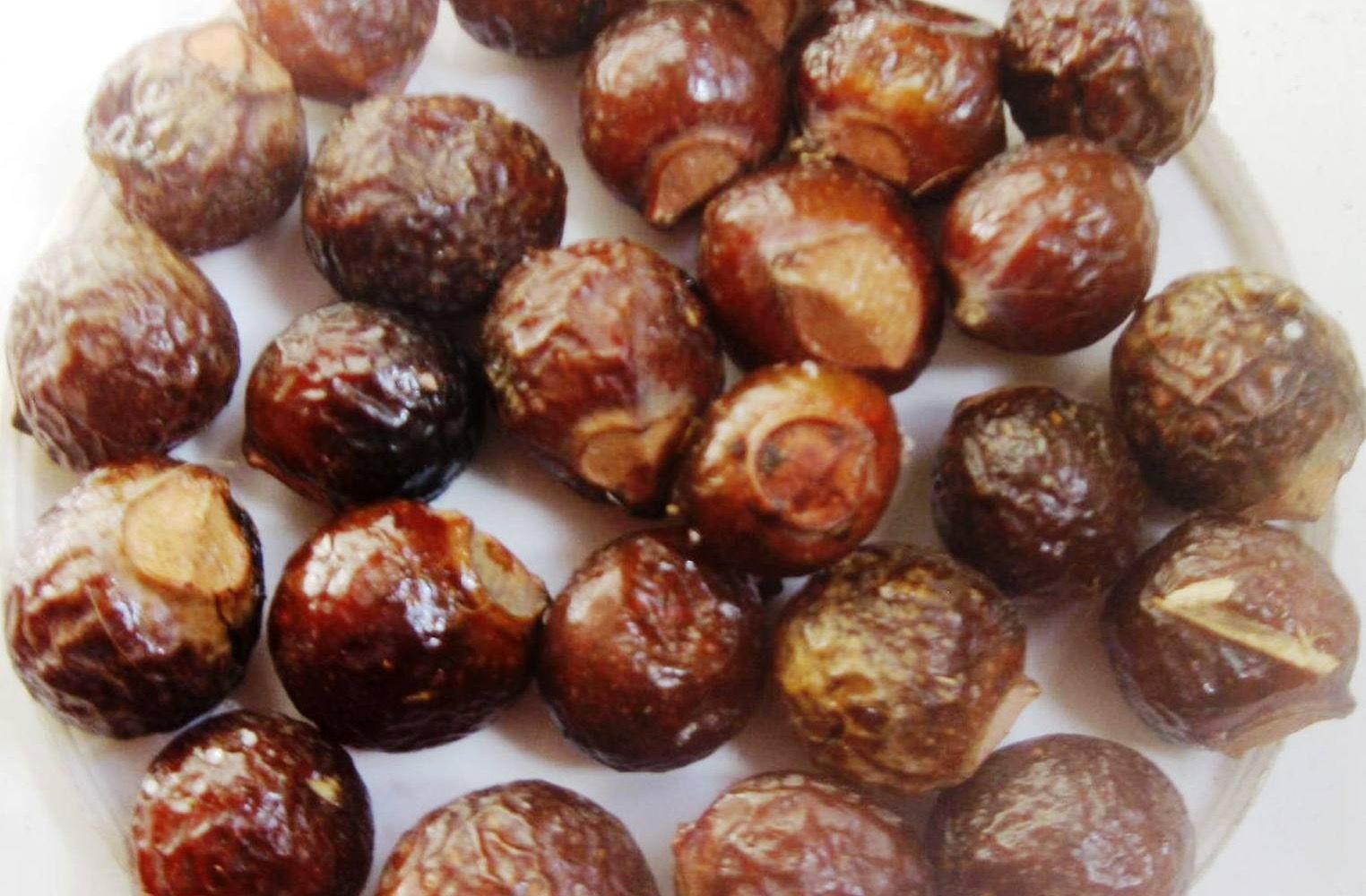
Soap nuts are the dried fruit of soapberry trees such as Sapindus mukorossi, the washnut. The fruit contains saponins, natural surfactants, and people where the tree grows use it as a natural detergent.
The cleaning evidence is thin. In one lab study, extracts of three Thai detergent plants, including a related soapberry, showed “moderate” foaming and cleaning power compared with a synthetic surfactant. That’s an extract in a lab, not whole nuts in a washing machine. Searching Europe PMC for soap nuts or Sapindus with laundry, washing or detergency, we found no published test of soap nuts washing clothes in a machine.
Eco Nuts calls them “the most effective natural cleaner on the planet” and cites no testing; its own how-to page says they “work great on some stains but not so great on others” and suggests pre-treating or oxygen bleach. Check what the bag they’re sold in is made of.
DIY detergent: washing soda and borax
The classic DIY recipe is grated soap, washing soda (sodium carbonate) and borax. It’s plastic-free if the ingredients come in cardboard, and it shares the soap bar’s problem: soap and hard water make scum. Two things to know about the ingredients:
- Borax isn’t the gentle mineral the recipes suggest. In the EU, borax (disodium tetraborate decahydrate) carries a harmonised classification as toxic for reproduction, category 1B (as of November 2026): “may damage fertility; may damage the unborn child”. That’s a hazard classification, what a substance can do at some dose, not a measure of the risk from laundry use. Still, it’s a good reason to leave borax out and keep the box away from children.
- Washing soda irritates eyes. Almost all companies notifying the EU’s chemicals agency classify sodium carbonate as causing serious eye irritation. Gloves and a scoop, not fingers.
We found no controlled study of how well homemade soap-soda-borax mixes clean clothes. One powder in the table, Meliora’s, is soap and soda, ready-made.
Where the plastic is
As of 21 November 2026, rechecked 22 November. Every entry comes from the maker’s own product, ingredient, FAQ or packaging pages. “Maker doesn’t say” means we couldn’t find it in writing. We didn’t test anything. This isn’t a ranking or a list of recommendations, and none of these products is listed on LPP, because our standard doesn’t yet cover detergents. “Plastic in the formula” applies our formula rule as explained above.
| Product | Format and packaging (maker’s words) | Plastic in the formula, by our rule | PVA film or sheet? | Where sold (maker) | Source |
|---|---|---|---|---|---|
| Meliora Laundry Powder (US) | Powder. “Paper can with steel ends and stainless steel scoop”, “uncoated paper label”. Refill: “outer paperboard box with inner paper bag” | None listed: baking soda, washing soda, coconut soap | No | Ships to the US only | Product, refill, shipping |
| Dr. Bronner’s Pure-Castile Bar Soap, peppermint (US) | Bar. “Packaged with 100% Post-Consumer Recycled (PCR) Paper”. Maker’s laundry recipe: grated bar plus baking soda, “not recommended for HE” | None listed | No | Maker doesn’t say on the pages we read | Product, recipe |
| Fels-Naptha Laundry & Stain Remover Bar (US) | Bar, sold as a stain pre-treater and booster for “your regular detergent”. Wrapper: maker doesn’t say | None listed: tallow, palm and palm kernel oils, sodium hydroxide, coconut acid, a terpene by-product, chelating agents | No | Maker doesn’t say | Product, ingredients |
| Molly’s Suds Original Laundry Powder (US) | Powder. Powders “packaged in a recyclable #7 plastic” | None listed | No | Target, Walmart | Product, FAQ |
| Nellie’s Laundry Soda (US) | Powder. Tin (cork in the lid), bucket (material not stated) or “plastic pouches”; scoop: maker doesn’t say | Plastic-minimal by our rule: linear alcohol ethoxylate (an ethoxylated surfactant; no chain length given, so counted unless the maker shows it’s below three units) | No | Continental US | Product, FAQ, shipping |
| Seventh Generation Free & Clear Powder (US) | Powder. Pouch, material not stated; no plastic scoop included | Plastic-minimal by our rule: laureth-6 (an ethoxylated surfactant, counted as a polymer) | No | Maker’s store finder | Product |
| Charlie’s Soap Laundry Powder (US) | Powder. Packaging: maker doesn’t say | Plastic-minimal by our rule: C12-16 pareth-9 and C10-14 alcohol ethoxylate (ethoxylated surfactants, counted as polymers) | No | Amazon, Grove Collaborative, Target, Walmart Marketplace; direct to some states | Product |
| Tide Original Powder (US, 95 oz) | Powder. Packaging: not stated on P&G’s ingredient record | Sodium polyacrylate, anionic modified polyester, organosilicone copolymer, C10-16 pareth (an ethoxylated surfactant, no chain length given). Also cellulose gum (not counted) | No | Maker doesn’t say in text | SmartLabel, Tide page linking it |
| Arm & Hammer Powder, Clean Burst (US) | Powder. Packaging: maker doesn’t say | Modified acrylic copolymer | No | Maker doesn’t say in text | Ingredient disclosure |
| Cleancult Liquid Laundry refill (US, 32 oz) | Liquid. “Paper-based” carton with “90% less plastic” than a standard plastic bottle; cap and lining material not stated | Plastic-minimal by our rule: laureth-7 (an ethoxylated surfactant, counted as a polymer) | No | Amazon or direct | Product |
| Blueland Laundry Tablets (US) | Tablet. “Forever Tins are made of steel”; refill pouches “industrially compostable”, with a “plant-based pouch zipper” (zipper material not named) | Newer formulas: sodium zinc polyitaconate, listed with sorbitan caprylate as one “process aid” entry; an ingredient maker’s (Itaconix’s) safety data sheet for its CAS number calls it a “homopolymer”, “highly water soluble”. By our rule that caps the newer formulas at plastic-minimal; it doesn’t rule them out. Older formulas on the same page list sorbitan caprylate without it, and a “proprietary” ester blend. Blueland says: “Our tablets are 100% plastic-free” | No: “Made without… PVA” | Costco, Whole Foods, Kroger, Meijer, Erewhon | Product, packaging, stores, Itaconix SDS |
| Dropps Laundry Pods (US) | Pod. “Curbside recyclable paperboard”; “Plastic-Free Packaging” | Polyvinyl alcohol film. The Crisp Breeze scent also lists nonionic polyester and a silicone copolymer | Yes | Maker’s store locator | Product |
| Earth Breeze Laundry Detergent Sheets (US) | Sheet. “Cardboard packaging”; liner: maker doesn’t say | Polyvinyl alcohol (“structuring agent”) | Yes | Maker’s store locator | Product, ingredients |
| Kind Laundry Detergent Sheets (US) | Sheet. “100% recyclable packaging”, “zero-waste packaging” | Polyvinyl alcohol (“binder”). Also “fatty alcohol polyglycol ether” (an ethoxylated surfactant, no chain length given), in a shorter second ingredient list on the same page | Yes | Maker doesn’t say in text | Product |
| Tru Earth Eco-Strips, Fragrance-Free (US, Canada) | Strip. “100% recyclable packaging”, material not stated | Polyvinyl alcohol (“structuring agent”); ethoxylated C12-18 alcohol (no chain length given) | Yes | Ships to the US and Canada | Ingredients, product, FAQ |
| Ecover Non-Bio Washing Powder (UK) | Powder. “This box is made with recycled cardboard”; inner bag: maker doesn’t say | Sodium polyaspartate; sodium carboxymethyl starch (a modified starch: whether it dissolves, which decides if our rule treats it as a microparticle, the maker doesn’t say). Laureth-7 and fatty acid methyl ester ethoxylates (ethoxylated surfactants). Also cellulose gum (not counted) | No | Morrisons, Ocado, Sainsbury’s, Tesco, Waitrose (linked from the page) | Product |
| smol Non-Bio Laundry Capsules (UK) | Capsule. “FSC®-certified cardboard”, “100% plastic-free packaging” | PEG; C12-18 pareth-7 (an ethoxylated surfactant) | Yes: film is “a polyvinyl alcohol” | Direct, by post | Product, ingredients, film |
| Resparkle Natural Laundry Powder (Australia) | Powder. “Plastic-Free & Compostable Bags”; its FAQ says its refill sachets are “made of corn” but doesn’t name the material | Sodium carboxymethyl cellulose (cellulose gum, not counted). “Coconut surfactant” and “natural enzyme blend” aren’t identified, so it’s not a full ingredient list | No | Ships within Australia only | Product, FAQ |
What the table shows:
- Two products clear all three tests in their makers’ words. Meliora’s powder lists no polymer, has no film, and its can, label, scoop and refill bag are all described as paper or steel. Dr. Bronner’s castile bar lists no polymer and is packaged in recycled paper, but its maker recommends it for laundry only in hot or warm water and not in HE machines. Fels-Naptha’s bar lists no polymer either; its maker doesn’t say what it’s wrapped in, and sells it as a booster for your regular detergent.
- “Plastic-free packaging” often sits next to plastic in the product. Dropps and smol say their packaging is plastic-free, and it may be. Their pod and capsule films are polyvinyl alcohol, by their own descriptions.
- The mainstream powders list several polymers each, and P&G and Church & Dwight are open about it: their published lists give each ingredient’s job.
- “Plant-based” isn’t the test. Blueland’s tablets skip PVA, and Blueland says they’re “100% plastic-free”. Its newer formulas also list sodium zinc polyitaconate, which an ingredient maker’s safety data sheet for that CAS number describes as a polymer that dissolves, so by our rule, which counts dissolved synthetic polymers, we can’t call those formulas polymer-free. That puts them at plastic-minimal at best, beside Blueland’s own claim; it doesn’t rule them out. Ecover’s polyaspartate and modified starch are in the same position.
- “Laureth” counts. Seventh Generation, Charlie’s Soap, Nellie’s and Cleancult list no polymer except an ethoxylated surfactant, and under our rule that alone makes each plastic-minimal at best. None of the products that clear all three tests lists one.
We’ll recheck this table every six months (next: May 2027). Spot something out of date? Tell us.
What to do
- If there’s a young child or someone with dementia at home, skip pods. That’s the best-evidenced reason to switch, covered in our pods explainer.
- Choose powder, then read the back. Look for a pack the maker describes as paper, card or metal all the way through, including any inner bag. Then check the ingredients for “poly-” names (polyacrylate, polyester, polyaspartate), PEG, “copolymer”, polyvinyl alcohol, and ethoxylated surfactants: “-eth” names with a number of 3 or more (laureth-7, pareth-9) or “ethoxylate”.
- Treat “plastic-free” on a sheet or pod as a packaging claim. If the ingredients list polyvinyl alcohol or PVOH, there’s plastic in the product.
- Go fragrance-free if you can. It’s the only way to be sure there are no fragrance capsules in the box.
- Leave the borax out of DIY mixes. And if you have hard water, expect any soap-based mix to need more product: soap reacts with the calcium to form scum.
For more swaps around the house, from laundry to the kitchen, see how to reduce plastic use, room by room. For the rest of the cleaning cupboard, see cleaning with less plastic.
Common questions
Are laundry sheets plastic-free?
Not by our rule. All three sheets and strips in our table list polyvinyl alcohol, for example Tru Earth as a “structuring agent”. It’s made to dissolve, so it generally falls outside the EU’s legal definition, but it’s a synthetic polymer, and EPA says “100 percent plastic-free” claims aren’t substantiated by its Safer Choice standard.
Is powder in a cardboard box plastic-free?
Only if the formula is too, and the box has no plastic liner or pouch inside. The York survey found polymers, broadly defined, in close to 100% of laundry detergents (liquids and powders counted together), and Tide Original powder, for one, lists sodium polyacrylate and a modified polyester.
Do soap nuts actually clean clothes?
Possibly, but nobody has shown it properly. Soap nuts contain saponins, natural surfactants, and a lab study found related plant extracts had “moderate” cleaning power compared with a synthetic surfactant. We found no published test of soap nuts in a washing machine. One seller’s own advice is to pre-treat stains or add oxygen bleach.
Is borax safe to use in homemade detergent?
The EU classifies borax as toxic for reproduction, category 1B: it “may damage fertility; may damage the unborn child”. That’s a hazard label, not proof of harm from laundry use, but a plastic-free routine doesn’t need it. Washing soda, the other usual DIY ingredient besides soap, is classed by almost all notifying companies as an eye irritant.
Sources
- Brunning H, Sallach JB, Boxall A (2025). Emissions of water-soluble polymers from household products to the environment: a prioritization study. Environmental Toxicology and Chemistry.
- European Commission (2023). Commission Regulation (EU) 2023/2055 amending Annex XVII to REACH as regards synthetic polymer microparticles. Official Journal of the European Union L 238/67 (27 September 2023).
- US Environmental Protection Agency (2023). Polyvinyl Alcohol (PVA); TSCA Section 21 Petition for Rulemaking; Reasons for Agency Response; Denial of Requested Rulemaking. Federal Register 88 FR 25590 (27 April 2023).
- Cai Y, Lin J, Gimeno S, Begnaud F, Nowack B (2022). Country-specific environmental risks of fragrance encapsulates used in laundry care products. Environmental Toxicology and Chemistry 41:905-916.
- Karagianni K, Kuntzmann-Dembele F, Bocokic V, Charbonnier A, Harrison I, Kreutzer G, Mendoza A, Jenner K (2024). Fragrance encapsulates: effect of polymeric shell purification method on the accuracy of biodegradability testing. Environmental Toxicology and Chemistry 43:1242-1249.
- European Chemicals Agency (ECHA) (2012). Guidance for monomers and polymers, Version 2.0. ECHA guidance on REACH (April 2012; read 22 Nov 2026 from a copy hosted by the Bulgarian environment ministry, as ECHA's site refuses automated fetches).
- US Geological Survey (2026). Hardness of water. USGS Water Science School (read 21 Nov 2026).
- Sochacki M, Vogt O (2022). Triterpenoid saponins from washnut (Sapindus mukorossi Gaertn.): a source of natural surfactants and other active components. Plants 11:2355.
- Wisetkomolmat J, Suksathan R, Puangpradab R, Kunasakdakul K, Jantanasakulwong K, Rachtanapun P, Sommano SR (2020). Natural surfactant saponin from tissue of Litsea glutinosa and its alternative sustainable production. Plants 9:1521.
- European Commission (2023). Commission Delegated Regulation (EU) 2023/1435 amending CLP Annex VI entries for boric acid, borates and 2-ethylhexanoic acid. Official Journal of the European Union L 176/6 (11 July 2023).
- PubChem (US National Library of Medicine) (2026). Sodium carbonate (CID 10340): GHS classification. pubchem.ncbi.nlm.nih.gov (read 21 Nov 2026).
- Meliora Cleaning Products (2026). Laundry Powder; Laundry Powder Refill; Shipping policy. meliorameansbetter.com (read 21 Nov 2026).
- Meliora Cleaning Products (2026). Laundry Powder Refill. meliorameansbetter.com (read 21 Nov 2026).
- Meliora Cleaning Products (2026). Shipping policy. meliorameansbetter.com (read 21 Nov 2026).
- Dr. Bronner's (2026). Peppermint Pure-Castile Bar Soap. drbronner.com (read 21 Nov 2026).
- Dr. Bronner's (2026). Castile bar soap dilutions guide. drbronner.com (read 21 Nov 2026).
- Summit Brands (2026). Fels-Naptha Laundry & Stain Remover Bar. summitbrands.com (read 21 Nov 2026).
- Summit Brands (2026). Ingredients. summitbrands.com (read 21 Nov 2026).
- Molly's Suds (2026). Original Laundry Detergent Powder. mollyssuds.com (read 21 Nov 2026).
- Molly's Suds (2026). FAQ. mollyssuds.com (read 21 Nov 2026).
- Nellie's (2026). Laundry Soda. nelliesclean.com (read 21 Nov 2026).
- Nellie's (2026). FAQ. nelliesclean.com (read 21 Nov 2026).
- Nellie's (2026). Shipping. nelliesclean.com (read 21 Nov 2026).
- Seventh Generation (2026). Laundry Detergent Powder, Free & Clear. seventhgeneration.com (read 21 Nov 2026).
- Charlie's Soap (2026). Natural Powder Laundry Detergent. charliesoap.com (read 21 Nov 2026).
- Procter & Gamble (2026). Tide Powder Laundry Detergent, Original, 75 loads, 95 oz (SmartLabel). smartlabel.pg.com (read 21 Nov 2026 via the page's data feed).
- Procter & Gamble (2026). Tide Original Powder Laundry Detergent. tide.com (read 22 Nov 2026).
- Church & Dwight (2024). A&H Powder Laundry Detergent, Clean Burst: ingredient disclosure. churchdwight.com (date of disclosure 26 March 2024; read 21 Nov 2026).
- Cleancult (2026). Concentrated Liquid Laundry refill, Juniper Sandalwood, 32 oz. cleancult.com (read 21 Nov 2026).
- Blueland (2026). Laundry Tablet Starter Set. blueland.com (read 21 Nov 2026).
- Itaconix (2023). Safety data sheet: Itaconix ONZ 105 (revision HCS2012 1.0, 9 November 2023). itaconix.com resources (read 22 Nov 2026).
- Blueland (2026). Packaging. blueland.com (read 21 Nov 2026).
- Blueland (2026). Store locator. blueland.com (read 21 Nov 2026).
- Dropps (2026). Laundry Detergent Pods. dropps.com (read 21 Nov 2026).
- Earth Breeze (2026). Laundry Detergent Sheets. earthbreeze.com (read 21 Nov 2026).
- Earth Breeze (2026). Ingredients. earthbreeze.com (read 21 Nov 2026).
- Earth Breeze (2026). FAQ. earthbreeze.com (read 21 Nov 2026).
- Kind Laundry (2026). Detergent Sheets. kindlaundry.com (read 21 Nov 2026).
- Tru Earth (2026). Ingredients. tru.earth (read 21 Nov 2026).
- Tru Earth (2026). Laundry Detergent Eco-Strips, Fragrance-Free. tru.earth (read 21 Nov 2026).
- Tru Earth (2026). FAQ. tru.earth (read 21 Nov 2026).
- Ecover (2026). Non-Bio Washing Powder. uk.ecover.com (read 21 Nov 2026).
- smol (2026). Laundry Capsules. smol.com/uk (read 21 Nov 2026).
- smol (2026). Laundry capsules information. smol.com/uk (read 21 Nov 2026).
- smol (2026). The encasing film (help centre). help.smolproducts.com.
- Resparkle (2026). Natural Laundry Powder (4 packs). resparkle.com.au (read 21 Nov 2026).
- Resparkle (2026). FAQ. resparkle.com.au (read 21 Nov 2026).
- Eco Nuts (2026). Deseeded Soap Nuts. econutssoap.com (read 21 Nov 2026).
- Eco Nuts (2026). How to use soap nuts for laundry. econutssoap.com (read 21 Nov 2026).
Spotted an error? Tell us and we'll correct it and note the change.