How long does plastic take to break down? Where the "450 years" comes from
The famous figures on beach posters weren't measured by anyone. What the degradation studies actually show, why sunlight matters more than time, and why "breaking down" mostly means breaking up.
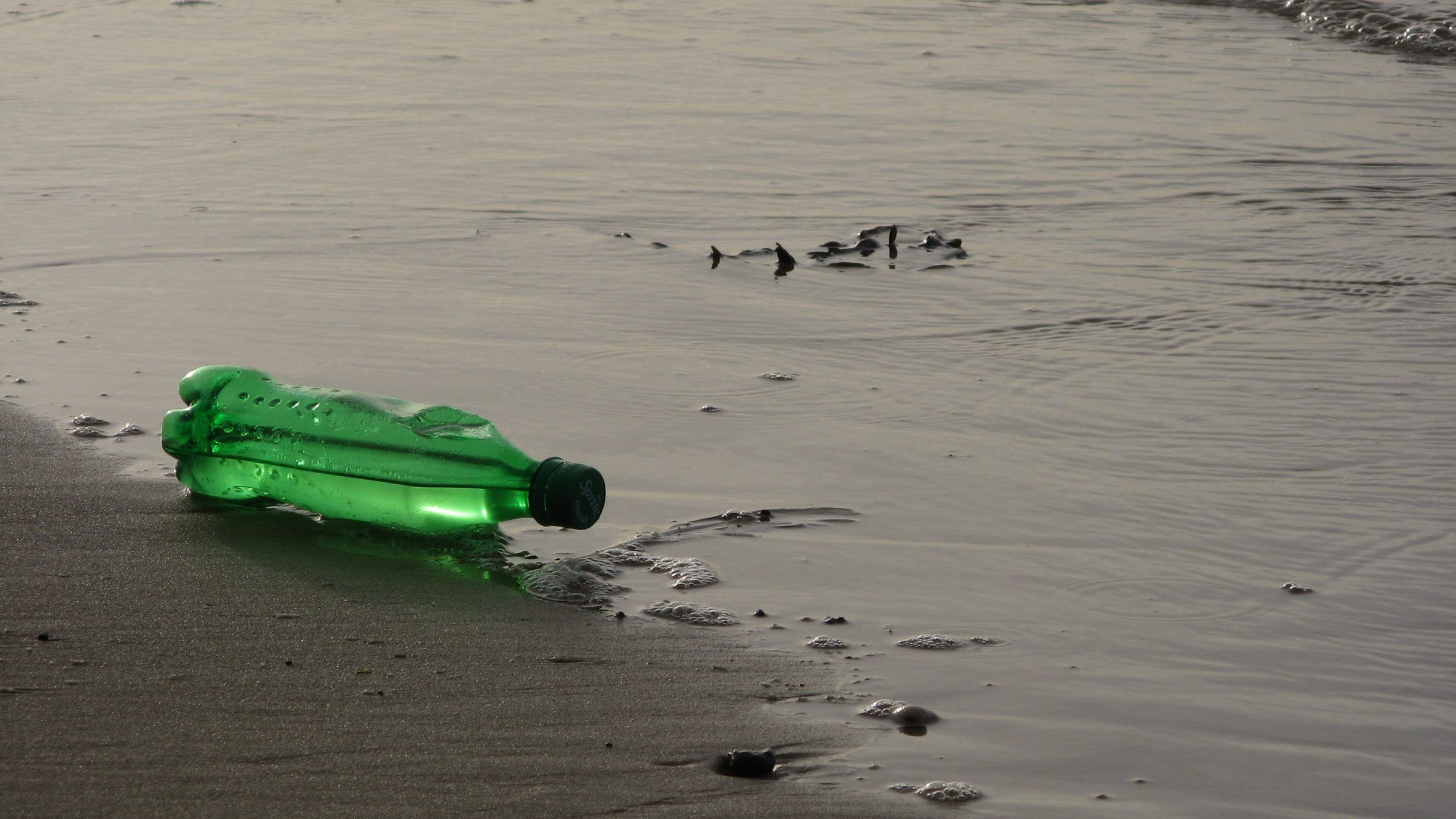
Every beach clean has one: the laminated poster showing how long your rubbish will outlive you. Banana peel, a few weeks. Aluminium can, 200 years. Plastic bottle, 450 years. Fishing line, 600.
They’re memorable, they’re shared by aquariums and government agencies, and they’re the first thing people quote when they want to say plastic lasts forever. The trouble is that nobody measured them.
That doesn’t mean plastic is harmless or brief. It means the real answer is stranger and, in some ways, worse: plastic doesn’t wait centuries and then vanish. It starts falling apart much sooner, into pieces too small to pick up.
Where the 450-year figure comes from
In 2020, two chemists at the Woods Hole Oceanographic Institution, Collin Ward and Christopher Reddy, went looking for the source of these numbers. They gathered 57 infographics and documents published by government agencies, non-profits, academic institutions, textbooks, companies and the media, and traced where each lifetime came from.
What they found:
- None rests on research. Not one of the 255 lifetime estimates on the 57 graphics was based on peer-reviewed literature, and 21 of the 57 (about 40%) gave no source at all.
- They all say the same thing. 40 of 54 estimates (about 75%) for a plastic water bottle said 450 years. The researchers found 37 graphics giving a lifetime for fishing line, all with exactly the same number: 600 years. Independent measurements don’t usually agree that neatly.
- They trace back to a few posters. The figures mainly came from three sources: the US National Oceanic and Atmospheric Administration (NOAA), Mote Marine Laboratory and Aquarium in Florida, and the South Carolina Department of Health and Environmental Control.
- The source says they aren’t science. The researchers contacted program directors at NOAA, who confirmed that these estimates are not based on peer-reviewed science.
Ward told his institution’s news team that, after digging for agency-funded research, he couldn’t find a single instance where the estimates came from a scientific study. The posters were made to start conversations, and they did. Then they were copied so many times that they began to look like data.
What the measurements actually show
The honest answer to “how long does plastic last?” is: it depends on which plastic, what shape it’s in, and where it ends up. And the evidence is thinner than you’d expect for a material we make hundreds of millions of tonnes of a year.
A 2020 review by researchers at the University of California, Santa Barbara pulled together the published degradation studies and converted them to a common measure: how many micrometres of surface a plastic loses per year. For high-density polyethylene (HDPE, the plastic of milk jugs and pipes) in the sea, measured rates ranged from practically zero to about 11 micrometres a year.
Shape matters as much as material, because plastic mostly degrades from the surface inwards. A thin-walled bottle has much more surface for its weight than a thick pipe. Using the average marine rate, the review’s extrapolated half-lives for HDPE ran from 58 years for bottles to 1,200 years for pipes. That’s a half-life (time to lose half the material), not a time to disappear. And it’s a model extrapolation, not an observation: the authors took an average measured surface-loss rate and projected it forward in a straight line. Nobody watched a bottle for 58 years. The authors’ main conclusion is a call for better experimental studies and standardised reporting.
Two other findings are worth knowing:
- In the same review, the plant-based plastic PLA, often sold as compostable, degrades about 20 times faster than HDPE on land, but at surprisingly similar rates in the sea. “Compostable” describes a factory, not a beach, as we explain in our compostable and biodegradable plastics guide.
- In a 2025 experiment in flowing seawater tanks at Woods Hole, plastic made from cellulose diacetate lost mass over 28 weeks, while polyethylene film showed no measurable degradation at either 10 or 20 °C.
So “450 years” isn’t a measurement, but it isn’t wildly wrong for some items either. The real range runs from years to more than a millennium, and for many common products nobody has done the experiment.
Sunlight does most of the work
Plastics like polyethylene, polypropylene and polystyrene have backbones of carbon atoms that microbes struggle to digest. What starts the damage is ultraviolet light and oxygen, which break the long polymer chains into shorter pieces. Only once the chains are shorter can microbes get much purchase, so in the sea, light-driven breakdown is expected to come before biological breakdown.
The most striking evidence comes from the same Woods Hole group. In a 2019 lab study, they exposed polystyrene, the plastic of foam cups and takeaway boxes, to simulated sunlight. It was completely oxidised to carbon dioxide and partly oxidised to dissolved organic carbon, on timescales they estimated as centuries for the complete conversion and decades for the partial one. That’s much faster than the “persists for millennia” assumption the authors say governments have relied on. Additives in the plastic changed the rate, and warmth helped only a little: about 25% faster with a 10 °C rise.
Before anyone takes that as permission: it’s one lab study, the authors say the method needs testing on other plastics, and in their later opinion piece they stress that the finding does not warrant disposal of polystyrene in the environment. “Dissolved organic carbon” also means the plastic, and whatever additives it carried, has become chemicals in seawater rather than ceasing to exist.
The flip side is the part that rarely makes the posters. If sunlight is a governing control on how long plastic lasts, then plastic out of the sun has far less to break it down. In a South Carolina salt marsh, plastic strips grew a coat of biofilm within weeks that cut the UV light reaching them by about 99%. Our inference, not a measured result: plastic buried in a landfill, sunk into mud or lying on the dark seabed is likely to last much longer than plastic floating in the sun. We found no field study that puts a number on it.
“Breaking down” mostly means breaking up
Here’s the bit that matters most. When plastic weathers, it doesn’t dissolve politely back into nature. It gets brittle, cracks and sheds pieces. That’s how most microplastics are made.
- In a lab. Korean researchers exposed plastic pellets to UV light for up to a year and then tumbled them with sand to mimic a beach. Polypropylene pellets produced about 6,084 fragments each after 12 months of UV and 2 months of abrasion. Low-density polyethylene was tougher, at about 20. Expanded polystyrene foam fell apart into 4,220 particles per pellet from sand alone, and 12,152 after six months of UV. Up to 76.5% of the foam’s volume couldn’t be found among the measured fragments, which the authors took to mean it had broken into particles smaller than a micrometre.
- In a marsh. In the South Carolina study, strips of HDPE, polypropylene and polystyrene were shedding microplastic fragments and fibres within eight weeks.
- In the open air. In a three-year Plymouth experiment, every carrier bag tested, conventional and “biodegradable” alike, had disintegrated into fragments after nine months outdoors.
So a bag that “disappears” from a hedge in a year hasn’t gone. It has become thousands of pieces you can no longer see. In the ocean, the surface fragments outnumber the big debris by an enormous margin, as we cover in our piece on ocean plastic and the garbage patch.
Biodegradable, oxo-degradable, compostable: do they solve it?
Not reliably, outside the conditions they’re designed for. In the Plymouth study, a compostable bag vanished in seawater within three months but was still present in soil after 27 months. The authors concluded that none of the bags could be relied on to deteriorate substantially over three years in every environment.
“Oxo-degradable” plastics, which contain additives to speed up breakdown, are worse at keeping their promise. A 2023 review found most of those studied reached only 5 to 60% biodegradation, and that field and lab studies had flagged possible microplastic formation. In other words, some of them are designed to fragment faster. The EU’s single-use plastics directive has banned all oxo-degradable plastic products since 3 July 2021; our recycling labels guide covers what the “biodegradable” claims on packaging are and aren’t allowed to mean.
Why the number matters less than where the plastic is
Most plastic ever made hasn’t gone anywhere near a sunny beach. Of the roughly 6,300 million tonnes of plastic waste generated by 2015, an estimated 79% was sitting in landfills or the natural environment (see our numbers page). Whether a given bottle lasts 50 years or 500, the total keeps growing, because we keep adding to it faster than any of it breaks down.
That’s also why the “450 years” framing can backfire. It suggests the problem is a slow countdown, and that a faster-degrading plastic would fix it. The evidence points the other way: faster degradation in the environment mostly means faster fragmentation, more microplastics and more released chemicals. The fix is less plastic getting out there in the first place.
What to take from this
- Stop quoting the poster numbers as fact. If you need a line, “plastic can persist for decades to centuries, depending on the type and where it ends up” is defensible. “450 years” isn’t, and it hands sceptics an easy target.
- Treat “it breaks down” as a warning, not a comfort. For conventional plastics in the environment, breaking down mostly means becoming microplastic. Strong evidence.
- Don’t count on biodegradable labels to clean up litter. Compostables need a composting facility; oxo-degradables are banned in the EU. Strong evidence for the bags tested; thin for most other products.
- Keep plastic out of the environment in the first place. Reuse, refuse and put waste in the bin, not the hedge. Picking litter up before it fragments is one of the few clean-ups that clearly works.
- Back better data. Scientists in this field say themselves that degradation rates for most everyday products haven’t been properly measured. That’s an honest gap, and it’s one funders and regulators could close.
Sources
- Ward CP, Reddy CM (2020). Opinion: We need better data about the environmental persistence of plastic goods. Proceedings of the National Academy of Sciences 117(26):14618-14621.
- Lubofsky E (Woods Hole Oceanographic Institution) (2020). The many lifetimes of plastics. WHOI News, 15 June 2020.
- Chamas A, Moon H, Zheng J, Qiu Y, Tabassum T, Jang JH, Abu-Omar M, Scott SL, Suh S (2020). Degradation rates of plastics in the environment. ACS Sustainable Chemistry & Engineering 8:3494-3511.
- Ward CP, Armstrong CJ, Walsh AN, Jackson JH, Reddy CM (2019). Sunlight converts polystyrene to carbon dioxide and dissolved organic carbon. Environmental Science & Technology Letters 6:669-674.
- Sun Y, James BD, Houston KR, Edwards B, Izallalen M, Mazumder S, Shankar R, Reddy CM, Ward CP (2025). Temperature controls the lifetimes and microbial communities degrading cellulose diacetate in the coastal ocean. Environmental Science & Technology.
- Song YK, Hong SH, Jang M, Han GM, Jung SW, Shim WJ (2017). Combined effects of UV exposure duration and mechanical abrasion on microplastic fragmentation by polymer type. Environmental Science & Technology 51:4368-4376.
- Weinstein JE, Crocker BK, Gray AD (2016). From macroplastic to microplastic: degradation of high-density polyethylene, polypropylene, and polystyrene in a salt marsh habitat. Environmental Toxicology and Chemistry 35:1632-1640.
- Gewert B, Plassmann MM, MacLeod M (2015). Pathways for degradation of plastic polymers floating in the marine environment. Environmental Science: Processes & Impacts 17:1513-1521.
- Napper IE, Thompson RC (2019). Environmental deterioration of biodegradable, oxo-biodegradable, compostable, and conventional plastic carrier bags in the sea, soil, and open-air over a 3-year period. Environmental Science & Technology 53:4775-4783.
- Sciscione F, Hailes HC, Miodownik M (2023). The performance and environmental impact of pro-oxidant additive containing plastics in the open unmanaged environment: a review of the evidence. Royal Society Open Science 10:230089.
- European Parliament and Council of the EU (2019). Directive (EU) 2019/904 on the reduction of the impact of certain plastic products on the environment. Official Journal of the European Union L 155.
- Geyer R, Jambeck JR, Law KL (2017). Production, use, and fate of all plastics ever made. Science Advances 3(7):e1700782.
Spotted an error? Tell us and we'll correct it and note the change.