Where your "recycling" goes: the global plastic waste trade
For decades rich countries shipped plastic scrap abroad and called it recycled. What China's ban changed, where the bales went next, what the Basel and EU rules do, and what it means for your bin.
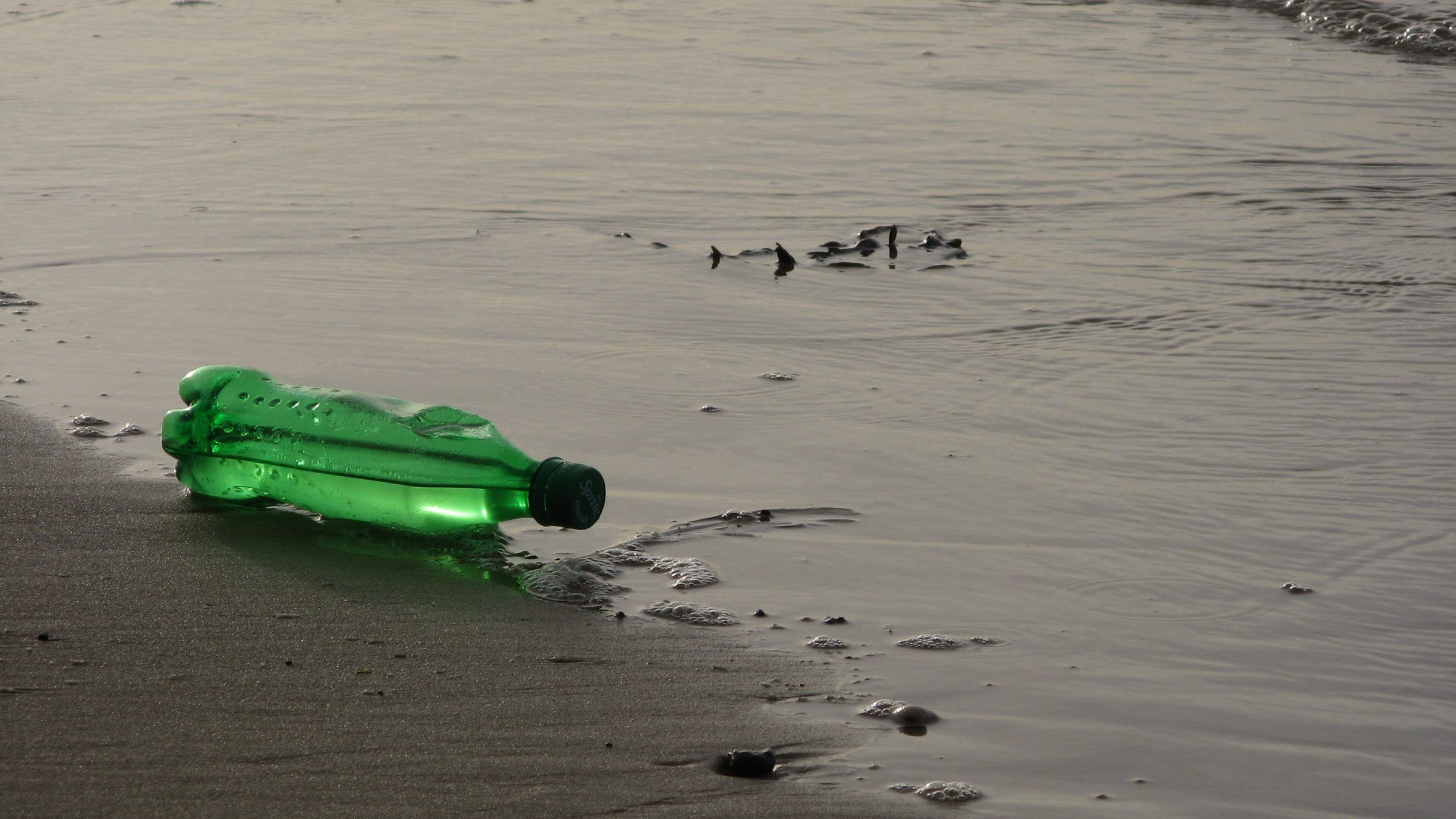
You rinsed the yoghurt pot. You peeled off the foil lid. You put it in the right bin, and for years a decent share of that bin’s plastic was baled, loaded into a shipping container and sent to the other side of the world, where somebody else had to deal with it. Back home, it went into the statistics as recycled.
This is the part of the recycling story the bin lorry doesn’t tell you. Here’s what the trade looked like, what changed when China said no, what the international rules now say, and what it all means for the plastic you’re still sorting.
How China became the world’s recycling bin
For about 25 years, the wealthy world’s plastic recycling system depended on China. A 2018 analysis of UN trade data found that China had imported a cumulative 45% of the world’s traded plastic waste since 1992. Higher-income OECD countries were the source of 70% of plastic waste exports in 2016, and 89% of everything exported over the years was polyethylene, polypropylene and PET, the polymers in most single-use food packaging. The same paper notes that upward of half of the plastic waste intended for recycling had been exported.
China’s factories wanted cheap feedstock, and exporters wanted somewhere to send it. In the US, exported plastic was counted as recycled without any proof it was, according to an analysis by two advocacy groups. We explain how that accounting inflates recycling rates in our piece on the recycling myth.
Asia as a whole took 74% of the world’s plastic waste imports in 2016. Mainland China alone was importing 5.8 to 8.3 million tonnes a year until 2017.
China closes the door
In July 2017, China told the World Trade Organization it would ban imports of 24 kinds of solid waste by the end of 2017, including “plastics waste from living sources”, meaning household and post-consumer plastic. Its stated reason was blunt: inspections had found that “large amounts of dirty wastes or even hazardous wastes are mixed in” with imported scrap, and this had “polluted China’s environment seriously.” The recycling industry came to call the crackdown that went with it “National Sword.”
The effect was immediate. China’s plastic waste imports dropped to 52,000 tonnes in 2018, from millions of tonnes a year before. Then, from 1 January 2021, China’s environment and commerce ministries, its planning commission and customs banned solid waste imports entirely.
The 2018 Science Advances study estimated that, if China held its line, about 111 million metric tonnes of plastic waste would be displaced by 2030: plastic that rich countries would have to deal with at home or send somewhere else.
They sent a lot of it somewhere else.
Where the bales went next
The trade didn’t stop. It moved. Between 2016 and 2018, Vietnam, Malaysia and other Asian countries saw significant increases in plastic waste imports.
The US numbers
A study of US Census data found that American plastic waste exports fell from about 1.4 million tons before the ban to 0.6 million tons after it, with Malaysia becoming the largest buyer, followed by Vietnam, Indonesia and Thailand. California was the biggest exporting state throughout.
We checked the trend ourselves in the UN Comtrade database, using the trade code for plastic “waste, parings and scrap” and the export figures the US reports. In 2016, US exports were worth about $734 million. By value, China took about 39% and Hong Kong, a major transit point into China, another 29%. By 2025, exports were about 386,000 tonnes, worth about $201 million. Canada took 37% of that tonnage and Mexico 18%, then India, Indonesia, Malaysia and Vietnam.
Two caveats. First, that trade code includes clean factory offcuts as well as post-consumer bottles and film, so not all of it came out of household bins. Second, Comtrade’s 2016 tonnage (about 1.95 million tonnes) is mostly its own estimate rather than reported weight, so we compare values, which aren’t adjusted for inflation. The direction is solid: by value, US exports fell by almost three-quarters. Being “down a lot” isn’t the same as stopping, though, and some of the remaining tonnage still goes to countries with weak waste systems.
Europe’s numbers
In 2016, the EU exported about 3.1 million tonnes of plastic scrap outside the bloc, according to the same Comtrade data (a figure that may include the UK, then a member). According to the European Commission, it has exported between 1 and 1.5 million tonnes a year in recent years, and 1.4 million tonnes in 2025.
The big change is the destination. With China gone and Southeast Asia tightening up, Europe turned to Türkiye. Turkish imports of plastic waste rose from 261,864 tonnes a year before China’s ban to 772,831 tonnes by 2020, according to a peer-reviewed analysis. In 2025, the EU sent Türkiye 510,000 tonnes, 36% of all its plastic waste exports. Counting the UK and other suppliers, Türkiye imported almost 700,000 tonnes that year.
What happened to it when it got there
This is where “recycling” gets tested. Not every exported bale was dumped; plenty of it was turned into pellets and new products. But the evidence that a meaningful share wasn’t comes from governments, peer-reviewed researchers and NGO investigators, and it points the same way.
Researchers’ estimates
A 2020 study estimated that in 2016, the US generated 42.0 million tonnes of plastic waste, more than any other country. Of the US plastic collected for recycling and shipped abroad that year, an estimated 0.15 to 0.99 million tonnes was inadequately managed in the importing countries: dumped, openly burned or leaked into the environment. Once that was counted, the US moved into the ranks of the countries contributing most to coastal plastic pollution.
The range is wide because nobody tracks what happens to a bale after it’s sold. That’s the problem in a sentence.
Governments’ own findings
- China gave contamination as its reason for the 2017 ban, and that rationale is in its WTO notification.
- Malaysia began sending waste back. In January 2020, its environment minister announced that 150 containers, 3,737 tonnes, had been returned to 13 countries, including 43 to France, 42 to the UK, 17 to the US, 11 to Canada and 10 to Spain. Authorities had also shut more than 200 illegal recycling factories, according to Associated Press coverage of the announcement.
- The European Commission, assessing Türkiye in September 2026, wrote that residual waste too contaminated to recycle is “openly burned or dumped” if not properly managed. It cited reports of fires at plastic storage sites around Adana and pollution reaching waterways and the Mediterranean. It also noted that stakeholders estimate only about 10% of Türkiye’s plastic waste is actually recycled. For the record, the Commission concluded that its findings “do not lead to the conclusion that Türkiye is failing” to manage EU plastic soundly, but point to the need for “substantial improvements”, and it plans to reassess by the end of 2028.
NGO investigations (labelled as such)
- Türkiye. Human Rights Watch interviewed 64 people in Istanbul and Adana, including 26 current or former recycling workers. They described breathing problems, severe headaches and skin conditions, with little protective equipment. HRW reported that Türkiye received nearly half of the EU’s plastic waste exports in 2020 and 2021. Some Turkish ministries didn’t respond to HRW. The environment ministry said it had carried out thousands of inspections of waste facilities since 2018, without giving data specific to plastic recycling.
- Indonesia. A coalition of four NGOs tested free-range eggs near a tofu factory in Tropodo, East Java, that burned plastic, much of it imported, as fuel. They reported the second-highest dioxin level ever measured in eggs in Asia, and calculated that eating one such egg would exceed the European tolerable daily intake for chlorinated dioxins 70-fold. That report wasn’t peer-reviewed, and local farmers, officials and some academics disputed it. A 2026 peer-reviewed study of 11 plastic-fuelled tofu sites in the same village found human-made microparticles in tofu from 9 of them, though its authors say they can’t pin those particles on plastic burning specifically.
- Vietnam. Peer-reviewed fieldwork in two “craft villages” describes plastic recycling that is largely informal, with real risks to workers’ health and the local environment.
The counterargument
To be fair, not every researcher concludes that trade is worse than the alternative. One 2024 modelling study of 2022 trade flows found that shipping plastic scrap to where it’s recycled produced lower environmental impacts than treating it at home with the average domestic mix of landfill, incineration and recycling. An earlier study found China’s ban improved four environmental indicators but added to global warming, partly because more plastic got burned or landfilled at home. The honest reading is that clean, sorted scrap sent to well-regulated recyclers can be fine. Mixed, dirty bales sent to places that can’t police them are how you get burning and dumping. The rules that came next tried to separate those two.
The rules: Basel, the US gap and the EU ban
The Basel Convention plastic amendments
The Basel Convention is the global treaty on shipping hazardous waste. In May 2019, its member countries agreed to bring most plastic scrap under its controls. Since 1 January 2021, shipments of most mixed, contaminated or hard-to-recycle plastic need the written consent of the importing country, and of any country it passes through, before they leave. Only a narrow category of clean, pre-sorted, uncontaminated scrap headed for proper recycling still moves without that consent.
The US isn’t a party
As EPA puts it, the US “is not a Party”, while 190 countries and the EU are. Basel parties generally can’t trade controlled plastic waste with non-parties unless there’s a separate agreement that meets the treaty’s standards. The US has one such agreement, through the OECD, and EPA lists separate requirements for trade with Canada and Mexico. That may help explain why those two neighbours now take most US scrap. At home, EPA says US exports of non-hazardous plastic scrap aren’t subject to export requirements under federal waste law. The paperwork happens at the receiving end, if it happens at all.
Importing countries are closing the gap themselves. Thailand banned imports of all plastic scrap from 1 January 2025. Malaysia’s tighter rules took effect on 1 July 2025 and, according to the Environmental Investigation Agency, an NGO, only allow shipments from Basel parties to apply for import approval. That shuts out the US.
The EU’s export ban
The EU went further. Its new Waste Shipment Regulation, Regulation (EU) 2024/1157, entered into force on 20 May 2024 and mostly applies from 21 May 2026. The key dates:
- 21 May 2026: all EU plastic waste exports, even clean fractions, need prior notification and consent from the countries involved.
- 21 November 2026: exports of plastic waste to countries outside the OECD are banned.
- No earlier than 21 May 2029: non-OECD countries can apply to be put on a list of approved destinations, if they can show they manage plastic waste properly.
That ban covers Malaysia, Vietnam and Indonesia. It doesn’t cover Türkiye, an OECD member, which is why the Commission is watching it. In its own words, the non-OECD ban “might lead to a shift of export flows of EU waste to OECD countries”. So the EU is closing one door and keeping a careful eye on the one most of its plastic already goes through.
What this means for your recycling bin
The trade is smaller than it was in 2016, but the core problem hasn’t gone away. Rich countries still produce more plastic waste than they can recycle at home, and “recycled” in the statistics has often meant “sold” rather than “made into something new.”
What you can do, in order of how much it actually matters:
- Use less of it. Every piece of plastic not made is a piece nobody has to export, burn or bury. This is the only option that doesn’t depend on the waste system working.
- Recycle the things that actually get recycled, and skip “wishcycling.” Clean PET bottles and HDPE jugs have real markets. Mixed, dirty or mystery plastic is exactly the low-grade material that ends up exported, dumped or burned. If your council doesn’t take it, putting it in the bin lowers the quality of the whole bale. Our resin code guide explains which numbers have real markets.
- Rinse and separate properly. Contamination was China’s stated reason for the ban. Cleaner bales are easier to recycle at home, and the Basel rules treat clean, sorted scrap differently from mixed, dirty plastic.
- Ask your council or hauler where your plastic goes. Some publish end-destination reports. If they won’t tell you, that’s an answer too.
- Push for policy. In the US, that means ratifying Basel and counting exported plastic as recycled only with proof it was recycled. In the EU, it means making the non-OECD ban stick and holding OECD destinations to the same standard. Packaging laws that make producers pay for collection and recycling at home change the economics that made exporting cheap in the first place.
Where the evidence is weak: nobody can tell you what share of exported plastic was actually recycled, because exporters stop tracking it at the dock. The best estimates come with huge ranges. That uncertainty isn’t a reason to relax. It’s the reason this system needed rules in the first place.
For how we source and grade claims, see our standards. For why your bin was never the main fix, read how the packaging industry made pollution your fault.
Sources
- Brooks AL, Wang S, Jambeck JR (2018). The Chinese import ban and its impact on global plastic waste trade. Science Advances.
- World Trade Organization, Committee on Technical Barriers to Trade (notification by China, Ministry of Environmental Protection) (2017). G/TBT/N/CHN/1211: Catalogue of Solid Wastes Forbidden to Import into China by the End of 2017 (4 classes, 24 kinds). WTO notification, 18 July 2017 (copy hosted by UNEP).
- Ministry of Ecology and Environment, Ministry of Commerce, National Development and Reform Commission, General Administration of Customs (China) (2020). 关于全面禁止进口固体废物有关事项的公告 (Announcement on matters concerning the total ban on solid waste imports), Announcement 2020 No. 53. Ministry of Ecology and Environment of China (in Chinese).
- Liang Y, Tan Q, Song Q, Li J (2021). An analysis of the plastic waste trade and management in Asia. Waste Management.
- Bourtsalas ACT, Yepes IM, Tian Y (2023). U.S. plastic waste exports: A state-by-state analysis pre- and post-China import ban. Journal of Environmental Management.
- United Nations Statistics Division (2026). UN Comtrade database: HS 3915 (waste, parings and scrap, of plastics), annual exports reported by the USA (842) and the EU aggregate (97), 2016–2025. UN Comtrade public API, queried 20 October 2026.
- US Environmental Protection Agency (2024). New international requirements for the export and import of plastic recyclables and waste. EPA website.
- European Parliament and Council of the European Union (2024). Regulation (EU) 2024/1157 on shipments of waste. Official Journal of the European Union, OJ L 2024/1157, 30 April 2024.
- European Commission, DG Environment (2026). Plastic waste shipments. European Commission website.
- European Commission (2026). Assessment of the sustainability of plastic waste exports to OECD countries pursuant to Article 45(5) of Regulation 2024/1157 on shipments of waste (SWD(2026) 274 final). Commission Staff Working Document, 1 September 2026 (Council doc. 12685/26).
- The Last Beach Cleanup and Beyond Plastics (2022). The real truth about the U.S. plastic recycling rate. Advocacy group report, May 2022.
- Law KL, Starr N, Siegler TR, Jambeck JR, Mallos NJ, Leonard GH (2020). The United States' contribution of plastic waste to land and ocean. Science Advances.
- Gündoğdu S, Walker TR (2021). Why Turkey should not import plastic waste pollution from developed countries?. Marine Pollution Bulletin.
- Human Rights Watch (2022). Turkey: Plastic recycling harms health, environment (release for the report 'It's as If They're Poisoning Us'). Human Rights Watch (NGO investigation), 21 September 2022.
- IPEN, Arnika, Nexus3 Foundation, Ecoton (2019). Plastic waste poisons Indonesia's food chain. IPEN (NGO report), 13 November 2019.
- The Jakarta Post (2019). East Java poultry farmers dismiss report on 'spoiled' eggs. The Jakarta Post, 26 November 2019.
- Nurika G, Wikurendra EA, Rumchev K, Alayyannur PA, Prambudi A (2026). Atmospheric particle deposition and anthropogenic microparticles in tofu from plastic-waste-fueled small-scale industries in Sidoarjo, Indonesia. Journal of the Air & Waste Management Association.
- Associated Press (via PBS NewsHour) (2020). Malaysia returns trash, says it won't be the world's waste bin. PBS NewsHour / AP, 20 January 2020.
- Environmental Investigation Agency (2025). Stricter controls on plastic waste imports into Malaysia come into effect. EIA (NGO) news, 1 July 2025.
- Pollution Control Department, Thailand (2024). Implementation of the Basel Convention amendments in Thailand (presentation to the Asian Network workshop). Ministry of the Environment of Japan, Asian Network annual workshop 2024.
- Salhofer S, Jandric A, Soudachanh S, Le Xuan T, Tran TD (2021). Plastic recycling practices in Vietnam and related hazards for health and the environment. International Journal of Environmental Research and Public Health.
- Li K, Ward H, Lin HX, Tukker A (2024). Traded plastic, traded impacts? Designing counterfactual scenarios to assess environmental impacts of global plastic waste trade. Environmental Science & Technology.
- Wen Z, Xie Y, Chen M, Dinga CD (2021). China's plastic import ban increases prospects of environmental impact mitigation of plastic waste trade flow worldwide. Nature Communications.
Spotted an error? Tell us and we'll correct it and note the change.